
Stan Albrecht: Five Years In
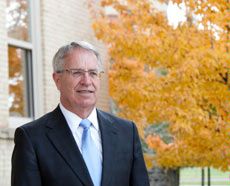
If formal approval ratings existed in higher education, Utah State University President Stan Albrecht's numbers would be approaching something suspicious. Something Orwellian. After five years in office, his levels of support are staggeringly high, making it hard to pen an interview–based half–decade review of his administration without sounding sycophantic. Just listen to the people around him. A staff member: “I would follow Stan Albrecht across hot coals because I believe in him as our leader.” A trustee: “Unequivocally, without a doubt, Stan Albrecht is the best president in the history of Utah State University.”
And in his own understated verbiage, “it's been a productive time.”
I haven't spoken much with Albrecht before I step into his office one frigid fall morning, but I feel like I know him. He knows me, knows my family. Asks how they're doing. That's what everyone had told me about Stan Albrecht — that he's all about people. His upbringing on a small farm in Wayne County, south central Utah, coupled with an educational background in rural sociology, makes him an easy fit with USU's land–grant mission: that education is democratic, and should be taken to all who qualify, regardless of socioeconomic status or geography. Extension VP and Dean of Agriculture Noelle Cockett says, “He's seen as someone who not only understands issues, but who has lived those issues.” And despite zero spare time, he still does. Give him a T–shirt from your club or organization and he'll sport it over his tie. Look for him at a gala, and you might find him in full suit, but sharing a laugh with the comfortably dressed cowboys.
Albrecht looks his usual self as he invites me to sit opposite him at the lacquered coffee table in his classy, muted office. This interview, like much of his presidency, would not be conducted from behind the desk. Nor, by the way, would it go as planned. It's common knowledge in Logan that Albrecht doesn't like to talk about himself, and in accurate anticipation that my questions would address his own personal triumphs and struggles, he heads me off at the pass. He produces a large packet of semi–loose papers anchored with a binder clip, and informs me that it's a list of the goals he set when he started out as president. There were 18, in no particular order. I could ask him whatever I wanted, but the real story of five years, as far as he's concerned, is in the facts. That's who he is.
“Time is precious, and we need to use it wisely”
The account of Stan Albrecht's ascension to the corner office has been told. Put forward in a 2000 national search to replace the retiring George Emert, Albrecht was second in the running to Kermit Hall, who then tapped him as provost. Albrecht's ability to cut through formalities and personally connect with people made him influential and popular in the position, and when Hall announced his resignation in 2004, Albrecht seemed like a natural choice for the presidency. Even so, he elected not to put his name forth again. “They know who I am,” he told his wife, Joyce, and of course, he was right. In a completely unprecedented move, trustees, faculty, staff, and students banded together to persuade the Board of Regents to forgo the customary national search and install Albrecht as president. According to Doug Foxley of USU's Board of Trustees, since Albrecht had come through a search four years previous, the regents conceded.
The Sunburst Lounge was packed tight, Cockett remembers, for the official announcement that USU had named its 15th president. When Albrecht's name was called, the crowd erupted into an emotional standing ovation as he strode to the pulpit. “There was such a wave of excitement and enthusiasm,” she says.
Truth be told, when Albrecht assumed office in February 2005, the university was in need of enthusiasm. Enrollment numbers had been sliding for four years as a result of House Bill 331, which made it harder for out–of–state students to obtain residency in Utah. Relations with the community were poor. Potential donors were dragging their feet. It was already an uphill climb for the new president long before the traumatic events of September 26, a day never to be forgotten by members of the USU family. “I was on my way to a meeting in Salt Lake City when I heard a radio report in Sardine Canyon that there had been a van accident with possible fatalities,” Albrecht recalls. “They didn't say it was ours, but something told me it was.” Following his instincts, Albrecht turned his car around and returned to Logan. He was nearing campus when a phone call confirmed his fear: Seven students and one instructor, all returning from a College of Agriculture research trip, had been killed. Another student would perish in the hospital that night, bringing the final toll to nine.
In the ensuing weeks, the first couple attended each of the viewings and funerals of the nine, and established lasting, compassionate relationships with their families. They still correspond on a regular basis. “We developed a special friendship with those families to carry on their memory in a way that will forever change this university,” says Joyce. “I don't know anyone that could have handled a tragedy like that like my husband.”
“Hardly a day goes by I don't think about it,” the president states of his and the university's own 9/11. “It reminds you that time is precious, and we need to use it wisely.”
Transformation: Our most important contribution
Albrecht's belated inaugural address, which was scheduled for the fall and cancelled in light of the tragedy, was titled “Transformation.” And though his call for change wasn't heard publicly, real evidence of such was already palpable in the bitter air. As the canyon wind loosened leaves across campus, many fell upon new terrain. Three of the most celebrated academic facilities in the West: the Merrill–Cazier Library, the Manon Caine Russell Kathryn Caine Wanlass Performance Hall, and the Jim and Carol Laub Athletics–Academics Complex were all under construction, and have since been completed [President Albrecht's Goals 4, 5, 6]. The president's silenced address, though, spoke not of buildings, but of three imminent themes for his tenure at the USU helm: providing access and opportunity, responding to 21st century globalization, and facilitating economic development.
Access seems to be a word with special meaning in the Albrecht household. It's spoken often. Joyce says access to education is what changed her husband's life, and it remains his highest hope that everyone might enjoy that same gift. He talks about it constantly in public, and becomes visibly impassioned as he brings it up in private. He's grateful for his parents, who couldn't attend college, but who made sure their children would. In “Transformation,” he says, “The founding philosophy of the public land–grant system is that education is altruistic, that expanding knowledge improves people's lives in real ways ý It is this process of personal and individual transformation that is perhaps our most important contribution.” On that individual level, Albrecht's devotion to access is manifested through an open–door policy, wherein any student may carry their questions and concerns straight into his office. Senior Chris Barney once exercised this right and approached the president with a question about athletics. After discussing it together, Albrecht felt that his response was inadequate, so he called Athletic Director Scott Barnes and asked him to meet with Barney to answer it better. “That the leader of a huge university would devote that much effort to one student's concern,” Barney says, “is incredible.”
On a broader scale, the “People's University,” as Albrecht likes to call it, carries a special land–grant responsibility to educate the state. It is to this end that he has focused so much attention on building the USU System [Goal 15]. Though it's easy for Cache Valley residents to miss, the USU system is constructed on a model already in use for many years in most other states, wherein the land–grant university operates several campuses of varying types. The system has flourished under Albrecht's direction. Enrollment is up 11 percent at the regional campuses of Brigham City, Tooele, and the Uintah Basin this year, and should collectively surpass the Logan student population before long. “We are one university, geographically dispersed,” he says, and the extent of the dispersion continues to grow along with overall size. The university has forged new partnerships with Snow College and the College of Eastern Utah, expanding options for those living in the southern and eastern parts of the state. In addition, Albrecht has increased the scope of the Extension program, which maintains a presence in each of Utah's 29 counties. Cockett says that Albrecht has a profound understanding of the “USU Family,” and that he's as committed to the students in the outlying campuses as he is to those in Logan. “He's gone out to the campuses many, many times,” she says. “Tooele had not even had a president visit them before.” Albrecht particularly enjoys attending the commencement ceremonies, which feature many non–traditional students with limited opportunities for education. “Those graduations tug at your heartstrings,” he says.
Albrecht is well aware that snowballing interest in distance learning is neither an anomaly, nor a fleeting fad. In his inaugural address, he pointed out that the 21st century brings changes, challenges and opportunities associated with globalization that must be addressed. Under his auspices, USU's reach is extending outward in other ways as well. Relations with the local community, formerly strained at times, have been much repaired [Goal 16]. Once a month, the first couple welcomes civic leaders to their home for breakfast and open discussion, in what Albrecht calls the President's Community Cabinet. Down I–15, Albrecht has become somewhat of a fixture at the state Capitol. He sometimes stays overnight in Salt Lake City during legislative sessions due to his frequency there, and he spends months preparing for meetings. According to Brent Miller, the university's Vice President of Research, Albrecht is “proactive in looking out for the best interests of higher education in Utah.” One of his first major victories in the state legislature entailed the championing of House Bill 118, which reversed HB 331. This, coupled with major recruiting efforts, has effectively stabilized USU's enrollment, which has been up for four straight years following the slide into 2005 [Goal 1]. Even at the federal level, Albrecht's presence in government is felt. Miller says, “He goes out of his way to meet with Senator Bennett, Senator Hatch, and Representative Bishop. He helps them understand our issues, and he enables them to help us.”
But as the word “globalization” denotes, Albrecht's and the university's reach should and does extend even farther. Collaborations with foreign institutions and governments have multiplied during his tenure [Goal 3]. Albrecht has met with the president of the Dominican Republic, and enhanced the agreement that brings dozens of its exceptional students to USU. Along with the road trips around Idaho and Utah to recruit students, Albrecht cites such international meetings as among the most fun things he's done as president. And he's done plenty of them. Programs have been developed in Armenia, China, Saudi Arabia, Korea, and elsewhere, and countless projects are underway in Africa. Most recently, Albrecht has secured the future of such ambitions with a new administrative position: Vice Provost for Global Engagement.
Back on campus, more classes are now being offered in such fields as intercultural communication. A full–fledged religious studies program has begun, and already features its own peer–reviewed journal [Goal 14]. Starting next year, students can minor in climate change. And though each college and department has hands reaching over the wall, so to speak, many of the university's newest globalization initiatives have emanated from the Jon M. Huntsman School of Business. Following a $25 million donation to the college from the noted philanthropist (and another million or so for the Armenian student exchange), the students, faculty, and programs have renewed energy, and accolades to show for it [Goal 7]. Global vision is one of the four pillars of emphasis of the new and improved college, and intensive international programs have sent dozens of students to five continents already.
The Huntsman donation has been one of the most publicized events in USU's history, but what many don't know is that university officials had been working with the philanthropist for about a decade in efforts to elicit such support. Sources say Huntsman was waiting for the right leader to come along.
He wasn't waiting alone.
Marc Bingham graduated from Utah State in 1963 and had only cursory contact with the university for about 40 years. But when President Albrecht paid the business leader a visit in 2007, hoping to install Bingham on a board, the Vernal native was ready with other ideas. “I'll build you a building,” he said, and within no time, construction on the Bingham Entrepreneurship and Energy Research Center was underway at the Uintah Basin campus. Bingham said that though they were meeting for the first time, he felt confident that his resources would be in good hands with Albrecht. In reference to the unexpected gift, Albrecht remarks, “You can go two lifetimes and not get something like that.”
At the time, Bingham's $15 million gift was the university's largest ever, only to be eclipsed by Huntsman's donation two months later. But as if 2007 wasn't productive enough, two weeks after the Huntsman announcement, and just before Christmas, President Albrecht came to the podium again. He had finalized a deal with the Emma Eccles Jones Foundation for $25 million for the College of Education and Human Services, which was then renamed in Jones's honor [Goal 8]. The Very Reverend Frederick Q. Lawson, a family member and foundation trustee, speaks of his “total confidence” in Albrecht as well. “He's good at sharing ideas with us,” he says, “as opposed to just coming upon us and saying ‘this is what we're doing.’”
Bingham talks about Albrecht's pent–up “nervous energy,” but at the potentially mortifying prospect of asking donors for huge amounts of money, the president appears remarkably collected. “It depends on the kind of relationship that's been developed,” Albrecht says. He simply keeps donors apprised of his “hopes and dreams” for the university. “At the end of the day, it isn't difficult. There's no need for an ask. I just say, ‘this is what it'll take.’” Albrecht resists accepting credit, and speaks noticeably sparingly on this subject. Joyce, who doubles as the university's Director of Stewardship Programs, knows all about fundraising, and reveals as though it's a secret, “They don't want to give unless they trust the leadership. You can't have a fundraising campaign without a good president.”
Yes, the campaign. Accepting the three largest gifts in USU history in three months wasn't entirely coincidental, even if it contained serendipitous elements. Albrecht recalls that from the time he started as Dean of HASS in 1998, he was made aware of a growing need to raise some serious money for a full–scale university transformation. “It took a long time to get off the ground, because we needed a strong leadership team, a set of reliable donors to build on, and significant research,” he says. “My predecessors were uncertain that it would succeed, and they didn't want to start a campaign and fail. But it was something that had to be done.”
Reliable donors: check. Strong leadership team: check [Goal 17]. In addition to those mentioned, Albrecht coaxed Ross Peterson, the current VP of University Advancement, to return home. Peterson and his 30–year history with Utah State and Cache Valley have been pivotal in fundraising efforts. Albrecht also brought in Fred Hunsaker, another recent retiree, to head up Business and Finance, and Ned Weinshenker, to act as the school's first–ever VP for Strategic Ventures and Economic Development. There are still others as well.
In fact, the university's only vice president who predates the Albrecht administration is Miller, in Research. There's a reason he stayed on. Thanks to his and Albrecht's efforts, and a more supportive business community, the state legislature approved the Utah Science Technology and Research (USTAR) initiative in 2006 [Goal 12]. USTAR is a program meant to advance the economic development of Utah by focusing increased levels of applied research on areas where the state and university already enjoy advantages, thereby maximizing marketability. The initiative embodies the fulfillment of the third concentration from Albrecht's inaugural address, and is now powering the region's economic engine with nine research teams and yet another new building on the way. Other recent research additions include the Energy Dynamics Lab, which works alongside USTAR, and which Albrecht hopes will exceed even the illustrious Space Dynamics Lab in its success. Significant research: check [Goal 2].
In March 2007, Albrecht felt the time had come, and announced the university's first–ever major comprehensive fundraising campaign, titled “Honoring Tradition, Securing Our Future” [Goal 10]. The effort, which the president says will go down as a major turning point in USU history, set a goal of $200 million by the end of 2010. However, with the team and research in place, and the three record–breaking gifts in tow, the campaign enjoyed early success beyond all anticipation. Within exactly a year of its commencement, and more than two and a half years ahead of schedule, the effort surpassed the $200 million mark. Bolstered by the success, Albrecht stood before a raucous celebration in Salt Lake City on August 6, 2008, to announce his intent to double the goal, and extend the deadline to 2012. Back in his office, the president leans back in his chair and laughs, reminiscing on the decision. “That was probably not the smartest idea,” he says. Within days, news broke that the economic downturn was morphing into a full–on global recession.
Though fundraising has slowed, the president hints at more than one large gift on the horizon. And though numbers for the past year aren't exactly pretty, the Albrechts are far from despairing. According to Joyce, “He will finish that $400 million goal. There's no question.” Her tone reveals an unwavering faith. The president takes a measured breath before responding: “We will.”
Giving a little to preserve something greater
Like many of us, Stan Albrecht is sick of hearing about the economic crisis. He'd prefer not to discuss it. However, his ability to fundraise and leverage new projects during this time is one of the two things he's most proud of from his time as president thus far. (The other is the expansion of the Regional Campuses.) In fact, though response has been mixed on the issue, Albrecht's handling of the budget has garnered much positive press.
The fact remains, though, that the university has sustained enormous blows not just from retracting donors, but in the form of massive budget cuts imposed by the constrained state legislature. Two rounds of cuts were administered during last school year, and more are in the works for at least the next two as well. Through tireless lobbying at the State Capitol, the president has managed to have a sizable portion of the proposed cuts reduced. Much of last year's remaining deficit was addressed via a controversial five–day unpaid furlough for all university employees. Despite friction from within, the decision has largely been praised for potentially saving dozens of jobs across the board. Father Lawson says, “He garnered support of the staff and faculty by asking them each to give a little.” Though an Episcopalian minister, Lawson likens the furlough to an LDS “fast Sunday,” wherein church members donate small amounts each month for the collective good. “We were asked to give a little to preserve something greater,” he says.
Most of the cuts thus far have been felt via reductions in workforce, and though the vast majority were unfilled positions and voluntary separations, 41 have still been laid off outright. It visibly pains Albrecht to think about such matters threatening his USU family, but Cockett says his are far from knee–jerk decisions. Albrecht seeks the input of all, and “turns issues around 360 degrees” to ensure that all possible implications are considered.
Albrecht explained the repercussions of the budget cuts in his first–ever State of the University address, given September 15 of this year. The president stressed in his low, quiet voice that he strives above all to be transparent and honest. (While most universities employ full–time speechwriters, Albrecht pens his own.) He's not a cheerleader. His tone at each event is solemn and forthright, and his controlled optimism not without foundation. The university continues to add facilities at a blistering rate. The David G. Sant Engineering Innovation Building is finished, and ground will be broken in May for a new Ag building on the site of the old Merrill Library [Goals 9, 11]. Both of these projects have required significant private and state funding, which Albrecht has been able to obtain despite the downturn. He adds that through campus–wide “thoughtful self–reflection,” reorganizations are taking place in order to increase efficiency and open new revenue streams. Such changes, Albrecht says, are meant not only to help defray costs, but to position the university for greater success in the future. The most notable of these reorganizations entails the prospect of separating the Caine School of the Arts from the unwieldy College of HASS, and establishing it as its own college. Albrecht admits that he didn't anticipate this development, though the idea for the school was initially his, conceived during his tenure as Dean of HASS. It became a reality soon after his appointment in 2005 [Goal 13].
Albrecht concludes the State of the University address with a call to faculty to remember what he calls “the honor of wearing the academic robe.” The privileges of connecting with talented students and accomplished colleagues, and researching challenging topics, make the quality of academic life higher than any other, he says. “I urge you to remember and celebrate that.”
Students first, in every decision
At the end of long days for the first couple, which days can entail functions for breakfast, lunch, dinner, and late dinner, it's not uncommon to see them together, helping to clean up after events and talking informally with students. When a rare gap exhibits itself in the Albrechts' schedule, they invite yet more students to their home. Cockett says, “It's never that the president is needed, it's that he wants to be there.” Albrecht certainly agrees. He values USU's unique place in the world, and loves the institution all the more because of it. Joyce says, “Every day we feel fortunate to be able to do this.” The job is, admittedly, more demanding than they expected coming in. She notes that it's nearly impossible for the two to disconnect and find balance by spending time with friends or family. But even amid complication, setback and triumph, Albrecht's focus remains as it's been all along: “Right at the beginning of his appointment, he made it clear that students come first,” Joyce notes. “Every decision he makes, the students' welfare always comes first” [Goal 18].
Stan Albrecht reaches the end of his bulky list and places it back on the coffee table. Eighteen up, 18 down. What exactly the future holds for Albrecht and the Aggies is yet to be seen, but his numbers—all of them—seem to be moving in the right direction. “What next?” I ask, and he leans back yet again in his chair.
“A few days ago, I made a new list,” he says.
Writer: Jeffrey Carr, Office of Public Relations & Marketing. Originally published in Utah State magazine, Fall 2009
SHARE
TRANSLATE
Comments and questions regarding this article may be directed to the contact person listed on this page.


