
Music - BM

About This Degree
When you pursue a music degree at Utah State University, you will find yourself immersed in a community of individuals committed to excellence, opportunity, and your future.
Come be a part of our impressive achievements and the exciting projects taking place in our department. The Bachelor of Music degree can be taken with an emphasis on music performance or music education.
BA vs BM
The primary difference between the BA and the BM is that the BM is a pre-professional degree, preparing students for careers in performance, education, or pedagogy, while the BA is a liberal arts degree, designed to develop broadly-educated musicians and citizens.
What You Will Learn
Students majoring in Music Performance at USU have the opportunity to focus on their specific instrument or voice, working with qualified faculty to hone their skills as professionals. Upon fulfilling the degree requirements, students in this program are qualified to enter the professional music business, ready for a career in music performance or private teaching, or to enter graduate studies in music performance.
The Bachelor of Music Degree in Music Education prepares students to teach general music, orchestra, band, and choir in elementary and secondary schools. Students may pursue an emphasis in choral, guitar/general, orchestral, or band education.
USU is proud to have a 100% job placement rate for music education program graduates who sought a music teaching position over the past three years. Utah State graduates are among the highest-qualified candidates for teaching positions in our state, and many of them are regarded as master-teachers and models for the profession in this region of the country.
Emphases:
Students must choose an emphasis in one of the following areas
Music Performance:
This emphasis prepares students for careers in music performance. Students can focus on piano, string instruments, harp, voice, wind/brass/percussion, guitar or organ. Students should check with the department for more information on the options available.
Music Education:
Students in this emphasis prepare to become music educators. In addition to music classes, they learn teaching techniques through classes taught by the College of Education. Students in this emphasis can focus on band, orchestra, choral, or guitar education.
Education Component
This is for the music education emphasis only. To obtain a secondary teaching license for grades 6-12, students must complete the 35-credit Secondary Teacher Education Program (STEP), which includes one semester of student teaching in a public school. This program is administered by USU’s School of Teacher Education and Leadership (TEAL) within the Emma Eccles Jones College of Education and Human Services. Student must apply to the School of TEAL the semester before taking STEP courses. This is usually the Fall of their Sophomore year, in conjunction with taking MUSC 3100 Motivation and Classroom Management Strategies Secondary Classroom Music. Students learn subject content through the Music Department and spend the last year or two studying education techniques through the STEP program.
Students in the music education program are required to select an emphasis related to their major instrument. Woodwind, Brass and Percussion instrument majors select Band Emphasis, Voice majors select Choral Emphasis, Guitar majors select Guitar emphasis, and Strings select Orchestra Emphasis.
ADVISING
At a Glance
College: College of Arts & Sciences
Department: Music Department
USU Locations:
- Logan campus
Faculty: View profiles of faculty members on the department directory.
Learn More: Program website
Program Requirements
Career And Outcomes
Career Opportunities
With a degree in music, students may pursue the following careers:
Music Performance Emphasis:
- Private studio instructors
- Corporate positions in the music industry
- Studio musicians
- Touring musicians and recording artists
- Music dealership owners and managers
- Recording engineer
- Sound technician
- Music journalist
- Music arrangement
Music Education Emphasis:
- Private studio instructors
- Music teachers in secondary schools (band, choir, etc.)
Job Outlook
USU Locations
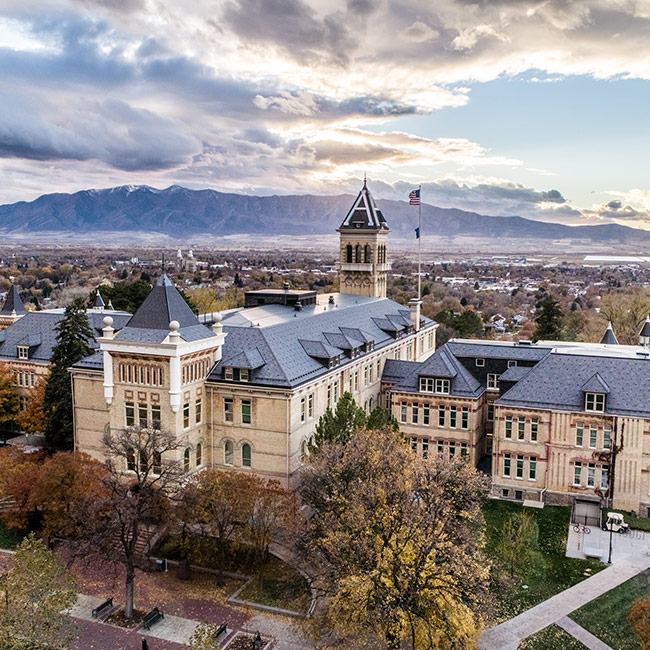
LOGAN CAMPUS
Admission
Admission Requirements
In addition to Utah State University’s admissions requirements, the music program has additional requirements:
- Music Application and Auditions: Incoming music students must apply to the music program and complete an audition to be accepted into the program. Visit the Music Application and Auditions page for the application and audition requirements.
- First-Year students: First-Year students admitted to USU in good standing qualify for admission as pre-majors.
- Transfer Students: Transfer students from other institutions need a 2.75 cumulative GPA to qualify, and students transferring from other USU majors need a 2.75 cumulative GPA to qualify for this major.
- To become a music major, students must complete the following:
- A required audition, which usually takes place the February before the student's first year.
- Other prerequisite coursework as determined by the department.
- STEP Requirements (music education emphasis only): To be accepted into STEP, students must go through an application process, which includes the following:
- Complete 60 semester credits with a minimum GPA of 2.75.
- Complete certain core courses (see department for more information).
- Complete a speech and hearing test.
- Pass the Teacher Education Writing Exam.
- Provide an unofficial copy of your transcript.
- Pass a criminal background check (this should be done one semester before submitting the application).
International students have additional admissions requirements.
Program Requirements
It is recommended that students have their own instruments. It is also recommended that students have a laptop computer and be familiar with music software (Finale), which they can access in university computer labs.
Take The Next Step
Visit Campus
Schedule a campus tour and come see what it's all about.
Cost and Aid
Learn about tuition, scholarships, and other financial aid opportunities.
How to Apply
Start your degree path and apply now.
You May Also Be Interested In

Elementary School Music Teaching
This minor is a great addition to early childhood or elementary education majors who want to gain a more rounded understanding of music and pass their knowledge of piano, guitar, and singing on to students in an elementary setting.

Music
Along with providing students a foundation in music theory, history, piano, and aural skills, the Bachelor of Arts is a liberal arts degree, designed to develop broadly-educated musicians and citizens.

Music Studies
Learn to listen to music with intention after classes in this minor, fostering a lifelong appreciation of all forms of music. Classes cover the fundamental theoretics, notations, cultures, and historical contexts of music.

Piano Pedagogy
This minor prepares students for professional careers running independent piano studios or music schools, such as teaching one-on-one lessons and group classes to piano students of all ages.