
World Water Expert to Discuss the Global Freshwater Challenge
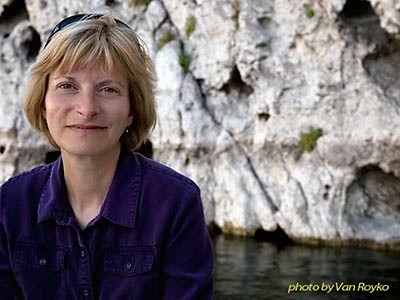
(Photo by Van Royko) Sandra Postel speaks at Utah State University Sept. 21.
Water is used everywhere, from producing electricity to helping plants grow. But did you know that the average American lifestyle requires nearly 2,000 gallons of water per day — twice the global average?
Sandra Postel, director of The Global Water Policy Project and a widely recognized expert on world water systems and policy, will speak about this and other water issues in her lecture “The Global Freshwater Challenge: New Solutions for a Thirsty World” at Utah State University Sept. 21 at 4 p.m. in the Agricultural Sciences building, Room 101.
“At this moment, we as a society are like the frog that chooses to stay in a warming pot of water as the heat is gradually turned up — unable to grasp the dire consequences of incremental change,” Postel notes on the organization’s website. “Inch by inch, the water tables drop. Mile by mile, the rivers run dry. The trends are not good. Yet we stay the course, refusing to recognize that, for safety’s sake — for survival itself — a big change is necessary.”
Postel, and has focused her career on studying worldwide freshwater systems and related ecosystems. The organization she heads promotes the preservation and sustainable use of Earth’s fresh water through research, writing and outreach. She is also a Fellow of the National Geographic Society where she is the lead expert for the society’s freshwater restoration and conservation campaign, and author of the award-winning book Last Oasis.
Postel’s lecture is open to the public and hosted by USU’s College of Agriculture and Applied Sciences as part of the university’s Year of Water, a celebration highlighting water-issues and water research, including the local and international impact of water research and teaching at USU.
More information about water research at USU can be found online. More information about The Global Water Policy Project can also be found online.
Contacts: Lynnette Harris lynnette.harris@usu.edu, 435-797-2189; Kelly Kopp kelly.kopp@usu.edu
Writer: Shelby Ruud shelby.ruud@usu.edu


SHARE
TRANSLATE
Comments and questions regarding this article may be directed to the contact person listed on this page.


