
Utah State University Announces Annual Diversity Award Recipients
Utah State University has announced the recipients of its 17th Annual Utah State University Diversity Awards.
The recipients for the 2010-2011 school year are H. Scott Hinton, Julie Smart, Jeannie Pacheco, Brooke Evans, Rigo Chaparro and members of the Uintah County School District/Ute Tribe Education Board. The awards recognize individuals on campus and in communities served by USU who have made significant contributions to affirmative action, equal opportunity or diversity.
H. Scott Hinton
H. Scott Hinton is recognized in the category of administrator.
He works closely with department heads to develop data-driven performance reviews so faculty members are evaluated with the same criteria regardless of race, ethnicity or gender.
He works to offer increased opportunities for female students through support of a “Women in Engineering Seminar” and provides support for the Society of Women Engineers student chapter; which has more than doubled in size.
He supported funding for the establishment and operation of the Society of Hispanic Professional Engineers and the National Society of Black Engineers.
He supports Engineers Without Borders, providing students with opportunities to develop engineering solutions for problems in third-world countries.
Hinton has been active in increasing faculty diversity by tripling the number of international faculty and increasing the number of female faculty members in the college by 50 percent. He challenges search committees to seek out diversity in applicant pools and provides assistance and resources in support of the USU Dual Career Assistance policy.
He has personally surrounded himself with diversity as two of the three associate deans in the college come from underrepresented groups.
Julie Smart
Julie Smart is recognized in the area of faculty.
She directed the Rehabilitation Counseling master’s program from 2001 to summer 2010, obtaining various training grants to assist students with over $6.6 million in tuition and stipends.
She developed a general education course, Society and Disability, taken by approximately 440 students over five semesters that introduces them to disability varieties, individual and familial adjustment to disability, and society’s reaction to people with disabilities.
Smart has written two editions of the widely used textbook Disability, Society, and the Individual, which discusses the prejudice and discrimination individuals with disabilities have experienced throughout history. The Journal of Applied Rehabilitation Counseling has cited her as the most prolific author on multicultural issues in rehabilitation.
Smart has developed an agreement with the University of Puerto Rico in which students from USU can undertake practicum and internship experiences at UPR and UPR rehabilitation counseling students will be able to complete their clinical experience at USU.
Smart has developed a set of 10 CDs on “Counseling Racial/Ethnic Individuals with Disabilities” that are used in state agency training programs, including the Utah State Office of Rehabilitation and other university Rehabilitation Counseling programs.
She has also translated into Spanish two widely used rehabilitation instruments: The Acceptance of Disability Scale and The Client Satisfaction with Rehabilitation Services Scale.
Jeannie Pacheco
Jeannie Pacheco is recognized in the category of staff.
She serves as counselor, friend and confidante to approximately 1,000 international students and scholars on campus.
Pacheco is responsible for hiring the employees in the Office International Students and Scholars office, which is staffed by individuals from different ethnicities, races, religions and sexual orientations.
For the past three years, Pacheco has encouraged her office staff to design and develop opportunities for the international students that create a strong connection to the USU community. Pacheco has fostered a comprehensive program through orientation and a Connections Experience.
She has worked with many organizations on campus such as the International Student Council and helped organize numerous activities to not only assist the international students in adapting to their new environment, but also to encourage the 1,000 plus international students representing more than 80 countries to share their culture with USU students and the community.
She has organized and implemented the English Conversation Program providing opportunities for international students to exercise their English skills with USU English-speaking students.
While some of the above work is certainly related to her position, all of the nominators emphasized how she goes the extra mile to assist the international community. She gives of her own time tutoring refugees and their families with speaking and writing English.
Brooke Evans
Brooke Evans is recognized in the student category.
She is an undergraduate student working on a dual major in geography and French and has indicated a goal is to work in international development in Africa.
She has served in leadership positions for Aggies for Africa as campus relations chair and more recently as vice president. She hopes to expand her work in Aggies for Africa and to learn more about African culture first-hand. She studied abroad in Ghana. While there she worked as a teacher and mentor for orphan children through the organization Mawauvio’s Outreach Program. She has been involved with the Ungana Foundation, working on the socio-cultural research team.
She took classes in Agricultural Land Use in the Developing World, Industrialization in the Developing World, and Population and Development while at the University of Ghana. She has remained active at USU as a Service Learning Scholar and a Quinney Scholar.
Evans has participated in the Multicultural Messiah performances and worked at the English Language Center, tutoring immigrants.
She has been involved in the Polynesian Student Union, the Black Student Union, the Fair Trade and Human Rights Club and Invisible Children Club.
Evans has been active in ASUSU, having served on Utah State Student Traditions and Activities Board on the Activities, Traditions and Arts and Lectures Committee.
She also helped diversify the incoming classes through her work as a “Friend” for the Admissions office.
Rigo Chaparro and Uintah County School District/Ute Tribe Education Board
For the first time in the community category, USU has two recipients and one of them is a “group” (also a first).
Rigo Chaparro served two years from 2008 to 2010 as the president of the Sky View High School Community Council and, at the same time, was the head of the Sky View Latino Student/Parent Support Group.
He organized a monthly community council meeting with parents, teachers and administration where items for school improvement, goals, objectives and activities were planned. He organized monthly meetings for the Sky View Latino parents and students where he helped them better understand the school’s goals.
Through various committee meetings, evenings with parent groups and discussions, he involved agencies in the area to help increase the knowledge base of the Latino population. BATC, USU and Bear River Health were a few of the organizations he involved to help educate the Community Council as well as Latino parents and students about preparation for the future.
Chaparro assisted with job opportunities, providing in-services for parents on child and teen family life and care by making personal contacts with parents and family members, particularly in the Latino community.
He organized a tour of the Sky View campus for the Latino parents where they were able to see the many opportunities and activities available to their children.
The other award in the community category is presented for the combined efforts of The Uintah County School District Board along with the Ute Tribe Education Board. In 2006, an elementary school and middle school were threatened with closure. These schools were central to the Ute Indian Tribe Reservation and had almost 100 percent American Indian enrollment.
The award nominations point out the efforts of several people in the above organizations, specifically Charlie Nelson (former district superintendent), Joanne Cowan and Perry Taylor (Uintah School District Board), and Ramalda Guzman and Raymond Murray (Ute Tribe Education Board).
As a result of the efforts of these individuals, the school board eventually voted to fund a major building project combining existing elementary and middle school facilities into a restructured K-8 school named Eagle View Elementary School.
Eagle View has become a coveted place to observe master teachers at work and to experience student teaching with a diverse student population. It should be noted that many of these student teachers come from the USU campuses in the Uintah Basin and surrounding areas.
Due to their efforts, Native American children in Uintah County now have more opportunities for a high-quality education.
Contact: Dave Ottley, dave.ottley@usu.edu
Writer: Rob Goates, 435-797-1356, rsgoates@gmail.com

USU Diversity Award recipients H. Scott Hinton and Julie Smart

Jeannie Pacheco and Brooke Evans
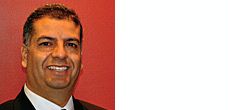
Rigo Chaparro
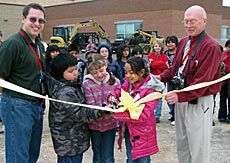
Ribbon cutting at the Eagle View Elementary School.
TOPICS
Awards 862storiesSHARE
TRANSLATE
Comments and questions regarding this article may be directed to the contact person listed on this page.


