
Utah State Bar Sponsors Traveling Magna Carta Exhibit at 800th Anniversary
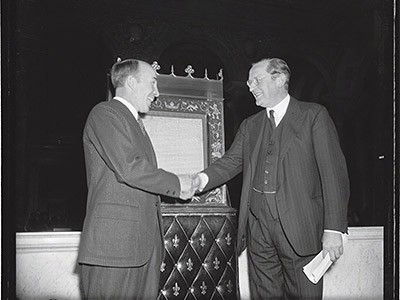
Magna Carta's first visit to the United States 75 years ago. British Ambassador Lord Lothian delivers Magna Carta to Librarian of Congress Archibald MacLeish for safekeeping during World War II. (photograph from the Utah State Bar’s Utah Bar Journal newsletter. (Photo courtesy Utah Bar Journal)
The Utah State Bar sponsors a travelling exhibit that marks the 800th anniversary of the Magna Carta, and residents of Cache Valley can take advantage of the rare opportunity and celebrate — via the exhibition — the introduction of the rule of law.
The traveling exhibit “Magna Carta: Enduring Legacy 1215-2015” can be seen at Utah State University’s Merrill-Cazier Library April 10 and 11 from 9 a.m. to 6 p.m. The exhibit is shown at the library’s atrium area.
The exhibit is free and open to the public during its two-day stop.
The exhibit was developed by the American Bar Association, a voluntary professional membership organization and voice of the legal profession, and the Library of Congress, the nation’s oldest federal cultural institution and the largest library in the world.
“Magna Carta: Enduring Legacy 1215-2015” includes images of documents, books and other objects from the Library of Congress collections that illustrate Magna Carta’s influence throughout the centuries and explain the document’s long history.
Eight hundred years ago, in a grassy meadow at Runnymede, England, King John and rebellious barons forged a short-lived practical solution to a political crisis of the highest ranks of feudal society. It was annulled 11 weeks later by Pope Innocence at King John’s urging, triggering a civil war. Subsequent kings reissued the great charter four times during that century, maintaining the original guarantee of “the law of the land.”
Magna Carta was the first significant step in a process of safeguarding constitutional freedoms that continue today.
“Magna Carta was a failed peace treaty,” said Nathan Dorn, Law Library of Congress curator of rare books who also curated the travelling exhibit.
And, despite its initial inefficacy, Magna Carts is full of ideas that live on in our public life and our constitutional jurisprudence, Dorn said.
“Our ideas of limited government, trial by jury, due process and the writ of habeas corpus are all part of a tradition that’s 800 years old,” he said.
In the early 1600s, legal scholar Edward Coke looked for an ancient basis for limiting the power of the king and he found it in Magna Carta. He developed a document that became required reading for lawyers, and it later impressed American revolutionaries. Ideas from Coke’s interpretation found their way into the charters of American colonies and, eventually, to the U.S. Constitution. “The General Laws and Liberties of the Massachusetts Colony” (from 1672) references trial by jury, freedom from unlawful seizure of property and freedom from unlawful imprisonment. Pre-Revolutionary War pamphleteers popularized Magna Carta, especially the clause they read guaranteeing no taxation without representation.
“To them, Magna Carta was about the dangers of tyrannical government and the obligation of the citizenry to stand up for their rights,” Dorn said.
The Fifth Amendment provision that “no person shall … be deprived of life, liberty, or property, without due process of law” descends from Magna Carta.
Including the Logan dates, the traveling exhibit visits Utah April 3-19 through its Utah State Bar sponsorship.
The Utah State Bar was established in 1931 and regulates the practice of law under the authority of the Utah Supreme Court. More about the organization can be found at its website.
Contact: Sean Toomey, communications director, Utah State Bar, 801-297-7059, sean.toomey@utahbar.org
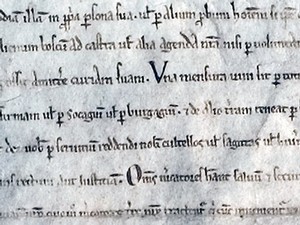
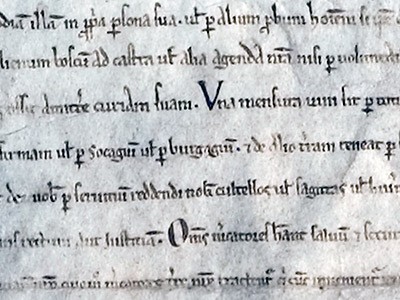
Detail from the historic document. (Photo courtesy Utah Bar Journal)
SHARE
TRANSLATE
Comments and questions regarding this article may be directed to the contact person listed on this page.


