
USU's Sunrise Sessions Discusses Early Detection of Childhood Hearing Loss
Several guests joined USU President Stan L. Albrecht at the Little America Hotel in Salt Lake City in late September to hear USU researcher Karl White present a lecture on the importance of detecting childhood hearing loss. The breakfast gathering was part of “Sunrise Sessions,” a lecture series designed to highlight timely and cutting-edge research conducted at Utah State University.
White, one of the world’s leading authorities on early identification and treatment of hearing loss, said that permanent hearing loss is the most frequent birth defect in the United States, affecting 12,000 newborns each year. If not detected early, childhood hearing loss dramatically interferes with a child’s language, learning and social development.
“Hearing loss is an invisible visibility and most babies born with the condition look and function normally,” said White. “Children today have the advantage of new science and technology that allows us to identify the condition at an average age of 3 months. This allows us to begin working with the child and family at the beginning of life so that they can communicate with one another.”
Deprived of these critical language learning opportunities because of an undetected hearing loss, children experience disruptions in social, emotional, cognitive and academic growth, said White. An article in the Journal of the American Medical Association warned that children with congenital hearing loss have delayed language, learning and speech development, and that these delays have life-long negative consequences.
“USU is a research university and we are honored to showcase our excellence in that area and Dr. White is a great example of the many good things we are doing,” said Albrecht.
White is a professor of psychology and founding director of USU’s National Center for Hearing Assessment and Management. His work has been recognized with awards from such diverse organizations as the Deafness Research Foundation, the American Association for Speech Language and Hearing, the Swedish Society of Medicine and the Alexander Graham Bell Association for the Deaf and Hard of Hearing.
He has hundreds of publications and presentations at scholarly meetings, and he has been an invited speaker to 29 countries where he has assisted in the implementation of newborn hearing screening and intervention programs. He also serves on many national and international advisory groups for organizations such as the U.S. Department of Health and Human Services, March of Dimes, the American College of Medical Genetics and the American Academy of Pediatrics.
In the fall of 2006, White’s work will be featured in a 30-minute Public Television documentary, “Voices of Vision,” a documentary designed to highlight the accomplishments of organizations “whose leadership efforts make the world a better place.”
“I am grateful to work at a university that is supportive and provides opportunities for research,” said White. “I am thrilled at how far we have come with my research here at USU, and I look forward to what the future brings.”
Reporter Lois M. Collins from the Deseret Morning News summarized White's presentation in a piece that appeared Oct. 1 (read the full item in the Utah State Today archives).
The lecture was sponsored by Regence BlueCross BlueShield of Utah.

USU President Stan Albrecht welcomed guests to the Sunrise Session in Salt Lake City.
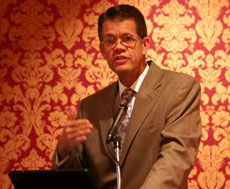
USU researcher Karl White discussed the importance of detecting hearing loss in newborn infants.
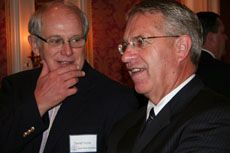
USU's Psychology Department Head David Stein visits with President Albrecht following the presentation.
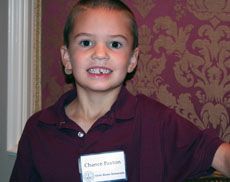
Chance Paxton attended the session. He has benefited from White's research in early identification of hearing loss.
SHARE
TRANSLATE
Comments and questions regarding this article may be directed to the contact person listed on this page.


