
USU Scientist Lauded for 'Most Cited Paper' in Journal 'Botany'
Utah State University botanist Hardeep Rai is celebrating the results of efforts he started more than eight years ago as a doctoral student at the University of British Columbia. The postdoctoral fellow was recently honored by the journal Botany as author of the publication’s most cited paper for 2008-09.
Formerly known as the Canadian Journal of Botany, the journal is published by the National Research Council Canada. Rai’s award included a $1,000 prize.
“When you’re doing this kind of biological research, you work with huge data sets and the fruits of that labor don’t tend to come until well after,” says Rai, who joined Department of Wildland Resources faculty member Karen Mock’s lab in June. “It’s really gratifying to receive this recognition.”
Rai was lead author on the paper, “Inferences of higher-order conifer relationships from a multi-locus plastid data set,” which appeared in the July 2008 issue of Botany.
“This work is a little step toward the ‘big picture,’” Rai says. “Basically, we’re making the case that all plants that have seeds can be traced to a single ancestor.”
Exploring this hypothesis, he says, involved “looking at a lot of DNA sequences for a lot of species.”
Plants with seeds range from conifers — pines, spruces and other evergreens with cones — to flowering plants and cycads, palm-like plants that made a memorable backdrop for such movies as Jurassic Park.
“There are hundreds of thousands of seed-plant species and many of them look nothing alike,” Rai says.
Methods for unraveling the evolutionary paths of these diverse organisms are much like those used to determine the origins of animals, including humans, he says. “And this big, tangled tree of life is much older for plants.”
One of the first challenges Rai encountered when he began the study was: how was he going to collect and manage enough DNA samples to conduct his research?
“It was a big collaborative effort and very labor intensive,” he says.
He was heartened by the enthusiastic response he received from scientists around the world to his inquiries and requests for DNA samples.
“The next big challenge was handling all the data,” Rai says. “I learned to be a computer scientist while being a botanist.”
The results of his computer-automated analysis, which look much like a genealogical chart, reveal striking connections between the vast range of species.
“Our findings strengthen some of the weaker points of connection and provide a good jumping off point for others to study these relationships,” he says.
After completing his doctorate at UBC, Rai headed to a postdoctoral fellowship position at Harvard where he continued his research.
“So many times, once you complete your doctoral research, you’re off to a completely new project,” he says. “I was very fortunate in that I got to take my PhD work and do a whole parallel study with different genomes that corroborated the conclusions of my doctoral studies.”
Now at USU, Rai is studying aspen transcriptome variation with Mock and professor Paul Wolf of USU’s Department of Biology. The project is a collaborative venture between Utah State, the U.S. Forest Service Rocky Mountain Research Station’s Provo Shrub Sciences Lab and Oregon State University.
“We’re looking at mRNA taken from aspen at test sites in Logan Canyon, Arizona and Montana and examining the differences,” he says.
mRNA or “messenger ribonucleic acid” is the carrier of information from DNA to the biological machinery that makes proteins, he explains. “It’s what makes life go. This research will hopefully help us make inferences about such factors as climate change and temperature adaptation.”
Rai says his new position allows him to leave the confines of the lab and get out in the field.
“That’s what I love about this job and USU,” says the British Columbia native. “I’m glad to be back in the Rocky Mountain West. And I already have my season ski pass for Beaver Mountain.”
Related links:
Contact: Hardeep Rai, 435-797-0279, h.rai@usu.edu
Writer: Mary-Ann Muffoletto, 435-797-3517, maryann.muffoletto@usu.edu
USU postdoctoral fellow Hardeep Rai was honored by the journal 'Botany' for having the publication’s most cited paper for 2009-09.
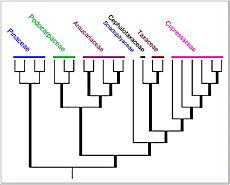
Detail from Rai's computer-generated analysis reveals ancestral connections between varied seed-plant species. The results look very much like a human genealogical chart.
SHARE
TRANSLATE
Comments and questions regarding this article may be directed to the contact person listed on this page.


