
USU Researchers Receive National Wildlife Research Center Award
Utah State University graduate Todd Atwood PhD’06 and Eric Gese, associate professor in USU’s Department of Wildland Resources, are recipients of a 2011 U.S. Department of Agriculture National Wildlife Research Center Outstanding Publication Award.
Atwood, who is a research wildlife biologist with the NWRC in Fort Collins, Colo., and Gese, also a research wildlife biologist with the NWRC in Logan, received the award for their paper, “Importance of Resource Selection and Social Behavior to Partitioning of Hostile Space by Sympatric Canids,” published in the April 2010 issue of the Journal of Mammalogy.
“This is prestigious, well-deserved recognition and Eric is making a habit of winning this award,” says Johan du Toit, professor and head of USU’s Department of Wildland Resources, who notes that Gese has received the award five times.
“Our paper focused on interactions between wolves and coyotes on Ted Turner’s Flying D Ranch in southwestern Montana,” says Gese, who was recently promoted to the grade of GS-15, the highest grade offered within the USDA.
Gese and Atwood, whose dissertation explored interactions between wolves, coyotes, deer and elk, investigated changes in coyote behavior following the reintroduction of wolves to Turner’s ranch.
“Prior to the wolves’ arrival, the coyotes generally preyed on small mammals,” Gese says. “They also hunted larger animals such as elk, but only when these large prey were greatly weakened by malnutrition.”
Once the wolves showed up, he says, the researchers observed that coyote packs followed hunting wolves and scavenged their kills.
“This practice is risky for the coyotes,” Gese says. “Initially, ‘naïve’ coyotes — that is, those unaccustomed to wolves — moved in to take advantage of the spoils too quickly and were killed by the wolves.”
He says the coyotes quickly adapted to the situation, however, and learned to “hold back,” waiting for the wolves to eat their fill and feed their young.
“This behavior in coyotes has also been observed in Yellowstone since the reintroduction of wolves,” Gese says.
The researchers also observed that the coyotes used numerical advantage to access the wolves’ loot.
“We saw that coyotes waited for opportunities to move in on carcasses and, if they had enough members in their pack, they could drive a few remaining, weaker wolves from the feeding site,” Gese says. “One-on-one, coyotes are no match for wolves but, en masse, they can successfully harass a few stragglers.”
Gese currently supervises seven graduate students. Since 1983, his field research on wild carnivores has focused on the behavior, ecology and management of coyotes, wolves, foxes and mountain lions in North America, plus jaguars and pumas in Brazil.
Related links:
- USU Department of Wildland Resources
- USU College of Natural Resources
- USU Ecology Center
- NWRC Predator Research Center
Contact: Eric Gese, 435-797-2542, eric.gese@usu.edu
Writer: Mary-Ann Muffoletto, 435-797-3517, maryann.muffoletto@usu.edu

USU alum Todd Atwood PhD'06 kneels beside a sedated wolf on Ted Turner’s Flying D Ranch in southwestern Montana. Atwood is currently a research wildlife biologist with the USDA National Wildlife Research Center in Fort Collins, Colo.
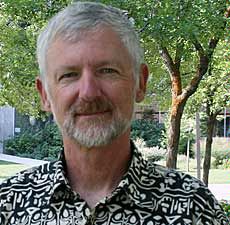
Atwood and faculty mentor Eric Gese, pictured, received a USDA publication award for a paper they wrote about research conducted at Turner's Flying D Ranch. This is the fifth time Gese has been honored with a publication award from the USDA.
TOPICS
Awards 862storiesSHARE
TRANSLATE
Comments and questions regarding this article may be directed to the contact person listed on this page.


