
USU Literacy Clinic Helps Students, Future Teachers and Future Students
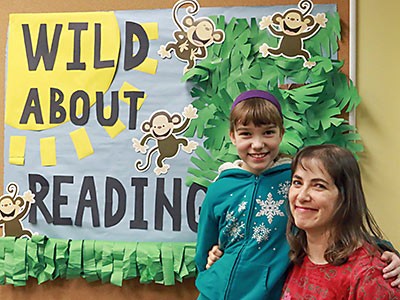
Janae and Jenna Shumway.
As a Literacy Clinic tutor, John Maynes wanted to see his student, Jenna, succeed. But first, she had to show up.
“Things were distant,” he said. “We didn’t hit it off immediately.”
Jenna agrees — initially, she didn’t love the idea of going to a reading tutor. She expected it would be a lot of reading out loud, which she didn’t enjoy. But her mother, Janae Shumway, knew her daughter could use some help with reading.
“I had looked in the summer for a tutor online, and I couldn’t find anybody that seemed to really work,” she said. “And then the third grade hit and it was pretty overwhelming.”
Then, Janae learned about the Literacy Clinic at Utah State University.
Cindy Jones, an associate professor in Teacher Education and Leadership, established the Literacy Clinic with several purposes in mind.
“We have a wonderful facility made possible by the Emma Eccles Jones Foundation that offered the perfect setting for a Literacy Clinic,” Jones said. “It is my goal to provide teacher candidates mentored training in literacy instruction and to aid public schools in helping elementary students develop reading and writing skills. A Literacy Clinic is just the place to do this.”
Together, the Shumways, Maynes and Jones would do far more than help a reluctant child. Their efforts would inspire a mother to continue her education and lead a reading program in a local school. Maynes would go on to take a teaching job in Kaysville, and he would later call his experience with the Literacy Clinic “the pinnacle of my work at USU.”
But first, he had a problem to solve.
At the beginning Jenna didn’t come, or came late. Sometimes she came but refused any of the incentives Maynes offered her for participation (he tried stickers, but she just said no). So John went back to the incentives survey that Jones encourages her reading tutors to use. In addition to finding out a student’s strengths and needs in reading, the tutors were asked to find out what was most likely to motivate a student to engage in reading.
Maynes learned that Jenna had an interest in art. And one night he woke up with an idea: For every time Jenna came on time, he would give her an origami paper crane.
He was not an origami expert, but he looked up instructions for making the cranes online. And somehow, paper cranes made the difference. Jenna started coming on time, and she discovered she liked working with Maynes. They did a reader’s theater of Mary Poppins, and acted out a scene, jumping into a chalk picture. Janae was the audience.
“He was just sweet,” Janae said.
At the end of the term, they made a mobile with the paper cranes Jenna had earned.
“It was just so positive, the one on one interaction,” Janae said. “It wasn’t like being tested. It was just fun.”
Jenna agreed. Even though she did end up reading out loud, she also played games, enjoyed herself, talked with her tutor (she has worked with more than one) and, most importantly, saw significant improvement in her reading skills.
It would be a happy story if it ended there — but the experience between Maynes, Director Jones and the Shumways has kept on giving.
“I felt like I should go back and take a class,” Janae said.
So she enrolled in a course with Jones at the graduate level. She came away from that experience with more insight and a determination to use her skills. Now she leads a program at Greenville Elementary in North Logan, Utah. The program uses volunteers and encourages students to read out loud.
Maynes said he uses what he learned from working at the Literacy Clinic to reach struggling readers. His coursework provided the components of literacy. The Clinic provided the context. “It was foundational,” he said. “The principles of teaching reading to struggling readers have carried over … even today, I pulled out some of those strategies that I learned.”
The future educators who work in the clinic will take away important skills, Jones said. The tutors spend the semester in their own mini-classroom teaching an elementary student. They gain valuable experience in classroom management, assessment, and literacy instruction. Their experience gives them the chance to apply what they learn on a small scale and later use it in their own classrooms.
“The bonds the tutors develop with the children and the differences they make are a confirmation to the tutors of the joys of the teaching profession,” Jones said.
Since its inception, hundreds of hours of tutoring services have been provided for local school children. The story of the Shumways and Maynes is just one example of how the Literacy Clinic is making a difference.
The work that started as an idea with a few tutors and children continues to grow each semester. The Literacy Clinic is now a course in the School of Teacher Education and Leadership within the Emma Eccles Jones College of Education and Human Services. The Clinic currently engages 50 children and tutors, with plans for continued expansion.
Tutoring services are available for students in grades K-5 who are above, at, or below grade level readers. To learn more about the Clinic, contact Cindy Jones.
To learn more about supporting USU’s Literacy Clinic, contact Lance Beckert.
Related links:
- Literacy Clinic
- School of Teacher Education and Leadership
- USU’s Emma Eccles Jones College of Education and Human Services
Contact: Cindy Jones, cindy.jones@usu.edu
Writer: JoLynne Lyon
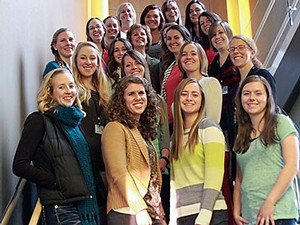
Tutors from the USU Literacy Clinic.
SHARE
TRANSLATE
Comments and questions regarding this article may be directed to the contact person listed on this page.


