
USU Historian Leonard Rosenband Returns from Visiting Professorships Abroad
Leonard Rosenband grew up on Long Island, New York during a time when Nazi tattoos inked the arms of his neighbors who had survived World War II. Early on, he learned the importance of studying the past and parsing it for meaning.
Looking back at world history, he fell in love with the French Revolution, its complexity and transformative effects — specifically, on the modern laboring classes and their experience in early industrialization. A professor of history at Utah State University, Rosenband focused his investigations on papermaking enterprises during this era, believing records would show just how a new type of worker and novel systems of labor management came to exist.
“Papermaking was not done by a single artisan or two,” Rosenband said. “It involved an elaborate division of labor and substantial capital resources, which means there are going to be records. It also means there is going to be conflict, and conflicts create records. Papermaking allows me to explore a set of issues that large forms of production entail, but that tend to be ignored in an early modern European world of crafts and small shops.”
However, 250-year-old business records can be difficult to access. They demonstrate a company’s deep roots in a particular industry and their quality of products. Not just anyone gets to write about them, he explained. “You have to win over the hearts of the people who own the documents.”
Thirty-five years ago, Rosenband flew to France to woo the owners for permission to review their files. After daily visits to the Montgolfier mill in Vidalon-le-Haut, France, and a letter of introduction from his mentor, a historian of French science, the dossiers were eventually opened for his examination.
“I had to prove I was serious,” Rosenband said.
The original documents were still in the basement of the historicmill and etched in script he had spent years learning to decipher. The owners kept records on individual workers, noting the journeymen’s attitudes and work habits, as well as documenting each man’s productivity. Rosenband selected this mill for case study because of a dispute between skilled journeymen and master papermakers, resulting in a strike and lockout of workers just before the French Revolution.
The events ultimately benefited the mill’s owners who were looking for ways to compete with new Dutch papermaking techniques. In an attempt to groom workers, they established a new kind of apprenticeship system, which transferred worker loyalties from other journeymen to the owners of the mill.
“This was an era where people were just beginning to see the potential of large-scale industrialization,” Rosenband said.
He catalogued the impacts technological advances had on production and evaluated the Montgolfiers’ business strategies. Rosenband used these details to highlight the influence of capitalism leading up to the French Revolution in his book Papermaking in Eighteenth-Century France: Management, Labor and Revolution at the Montgolfier Mill, 1761-1805 published in 2000 by The Johns Hopkins University Press. European economic and labor practices continue to be the focus of his work.
“It is far enough in the past that it is different, but not so distant as, for example, the ancient Roman world that can feel so far away it is very difficult to grasp,” Rosenband said.
He has a book under contract with the American Historical Association and the Society for the History of Technology, The Industrial Revolution, 1760-1830, and another longer book project underway on two centuries of papermaking in England and France.
Rosenband spent part of the 2010-11 academic year in as a visiting scholar at the University of Paris 1 Panthéon-Sorbonne in France and as a visiting professor at the Università degli Studi dell'Insubria in Italy. After several months of researching and teaching abroad, he was eager to get back into the classroom at USU.
“As much as I love the isolation of my study, I missed the exchanges with students, and I missed them,” Rosenband said.
He is teaching Europe and the French Revolution, 1700-1815 and the graduate seminar in History and Theory this semester.
Related links:
USU College of Humanities and Social Sciences
Contact: Leonard Rosenband, (435) 797-1296, leonard.rosenband@usu.edu
Writer: Kristen Munson, CHaSS PR specialist, (435) 797-0267, kristen.munson@usu.edu

The cover of Leonard Rosenband's book about papermaking in 18th century France.
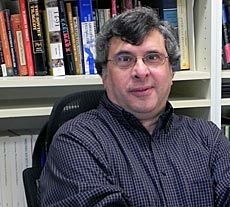
USU history professor Leonard Rosenband has returned to the USU campus after a spending parts of last year as a visiting professor in Europe. His research interests include papermaking enterprises during the French Revolution.
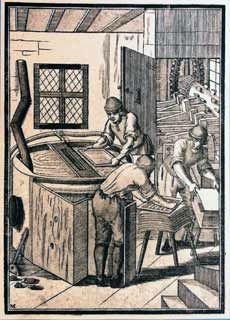
Detail from the book cover from an etching showing the paper making process.
SHARE
TRANSLATE
Comments and questions regarding this article may be directed to the contact person listed on this page.


