
USU Environmental Ed Program Receives Top State Award
The Utah Master Naturalist Program, an educational program coordinated by Utah State University Extension, received the 2009 Utah Environmental Education Program of the Year Award from the Utah Society for Environmental Education. Program coordinator Mark Larese-Casanova, an environmental educator with the College of Natural Resources’ Department of Watershed Sciences, accepted the award at the society’s annual conference held Nov. 19-22 in Salt Lake City.
“The nominations for the award came from my peers and that was particularly meaningful for me,” says Larese-Casanova, an extension education specialist. “This is a prestigious award for environmental education programs in Utah.”
In the award citation, the USEE commended the USU program for “helping program participants gain a personal stake and sense of responsibility in the stewardship of the state’s assets as well as giving them the skills to positively affect public awareness and conservation of Utah’s natural resources.”
Larese-Casanova began developing the program, which currently consists of two 40-hour modules, about three years ago. Nearly 80 students have participated in the Utah Watersheds and Utah Deserts modules and a third module, Utah Mountains, will be introduced in summer 2010.
“The program is similar in format to USU Extension’s Master Gardener program and is designed to equip naturalists with the knowledge and skills to become better stewards of Utah’s natural world,” he says. “The program is quite unique as it one of few environmental education programs targeted specifically to adults.”
The program’s participants include professionals – public and private school teachers and naturalists employed in the state’s natural centers, zoos and state and national parks – along with their amateur counterparts who are often volunteers at similar sites.
Based at USU’s Utah Botanical Center in Kaysville, the program’s modules are taught throughout the state and Larese-Casanova says he tries to spend more than 50 percent of instruction time in the field.
“Each participant receives a binder full of information, along with an instructional CD,” he says. “But being out in the field observing plants, animals and landscapes is where the most critical learning takes place.”
Classes are typically held one day per week for five weeks though some groups, including Southern Utah University, have requested weeklong sessions.
“For SUU we conducted a weeklong gathering because the field site was Bryce Canyon,” Larese-Casanova says. “It was an intensive class but the format worked very well in that setting.”
Salt Lake City’s Hogle Zoo and the Living Planet Aquarium in Sandy are among the organizations that have partnered with USU to teach the program to their employees, volunteers and the general public.
“No matter where the modules are taught, the curriculum is the same,” Larese-Casanova says. “However, the field portion of each class has a very local emphasis. Participants learn about management projects and issues related to the natural resources in their own communities.”
Ideally, he says, participation in the program will inspire participants to get involved in finding solutions for local environmental challenges. He plans to expand the program’s Web site with information about naturalist volunteer opportunities throughout the state, including an online sign-up system.
“I’ve been surprised and pleased with the enthusiasm of participants,” Larese-Casanova says. “We want to keep that enthusiasm going and provide a community where naturalists can share information with peers. Eventually, we’d like to establish chapters throughout the state.”
Related Links:
Utah Master Naturalists Program
USU Department of Watershed Sciences
USU College of Natural Resources
Contact: Mark Larese-Casanova, 435-797-8060
Writer: Mary-Ann Muffoletto, 435-797-3517
“The nominations for the award came from my peers and that was particularly meaningful for me,” says Larese-Casanova, an extension education specialist. “This is a prestigious award for environmental education programs in Utah.”
In the award citation, the USEE commended the USU program for “helping program participants gain a personal stake and sense of responsibility in the stewardship of the state’s assets as well as giving them the skills to positively affect public awareness and conservation of Utah’s natural resources.”
Larese-Casanova began developing the program, which currently consists of two 40-hour modules, about three years ago. Nearly 80 students have participated in the Utah Watersheds and Utah Deserts modules and a third module, Utah Mountains, will be introduced in summer 2010.
“The program is similar in format to USU Extension’s Master Gardener program and is designed to equip naturalists with the knowledge and skills to become better stewards of Utah’s natural world,” he says. “The program is quite unique as it one of few environmental education programs targeted specifically to adults.”
The program’s participants include professionals – public and private school teachers and naturalists employed in the state’s natural centers, zoos and state and national parks – along with their amateur counterparts who are often volunteers at similar sites.
Based at USU’s Utah Botanical Center in Kaysville, the program’s modules are taught throughout the state and Larese-Casanova says he tries to spend more than 50 percent of instruction time in the field.
“Each participant receives a binder full of information, along with an instructional CD,” he says. “But being out in the field observing plants, animals and landscapes is where the most critical learning takes place.”
Classes are typically held one day per week for five weeks though some groups, including Southern Utah University, have requested weeklong sessions.
“For SUU we conducted a weeklong gathering because the field site was Bryce Canyon,” Larese-Casanova says. “It was an intensive class but the format worked very well in that setting.”
Salt Lake City’s Hogle Zoo and the Living Planet Aquarium in Sandy are among the organizations that have partnered with USU to teach the program to their employees, volunteers and the general public.
“No matter where the modules are taught, the curriculum is the same,” Larese-Casanova says. “However, the field portion of each class has a very local emphasis. Participants learn about management projects and issues related to the natural resources in their own communities.”
Ideally, he says, participation in the program will inspire participants to get involved in finding solutions for local environmental challenges. He plans to expand the program’s Web site with information about naturalist volunteer opportunities throughout the state, including an online sign-up system.
“I’ve been surprised and pleased with the enthusiasm of participants,” Larese-Casanova says. “We want to keep that enthusiasm going and provide a community where naturalists can share information with peers. Eventually, we’d like to establish chapters throughout the state.”
Related Links:
Utah Master Naturalists Program
USU Department of Watershed Sciences
USU College of Natural Resources
Contact: Mark Larese-Casanova, 435-797-8060
Writer: Mary-Ann Muffoletto, 435-797-3517

Mark Larese-Casanova, director of the USU-based Utah Master Naturalist Program, displays a toad during a field outing. The educational program was named the 2009 Utah Environmental Education Program of the Year.
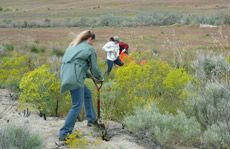
Utah Master Naturalist Program participants help manage dyer's woad, an invasive weed, on Great Salt Lake’s Antelope Island.
TOPICS
Awards 862storiesSHARE
TRANSLATE
Comments and questions regarding this article may be directed to the contact person listed on this page.


