
USU Computer Engineering Student Makes Winning Business in School Lotteries
Winning the lottery is something many Americans dream of, but the odds are against most at taking home that “winning” random number. Utah State University computer engineering student Joseph Irvine is betting on those odds and literally winning with his software written specifically for school admission lotteries.
Irvine’s intelligent lottery software pulls names from a database and assigns numbers to every person vying for a spot in the school. The program then randomly generates a list from one up to 50,000. The number one slot opening will have a person’s identity number next to it, thus ensuring them a place in the school. The software is animated so audiences can see what numbers are being selected by the program, and allows the results to be printed and saved.
Irvine’s intelligent lottery software pulls names from a database and assigns numbers to every person vying for a spot in the school. The program then randomly generates a list from one up to 50,000. The number one slot opening will have a person’s identity number next to it, thus ensuring them a place in the school. The software is animated so audiences can see what numbers are being selected by the program, and allows the results to be printed and saved.
Irvine realized the niche market for his lottery software, and began selling the product when he was a freshman at USU.
“I noticed USU’s Edith Bowen Laboratory Elementary School held a kindergarten lottery,” Irvine said. “I approached them and asked if they would be interested in using my software. They said they were and began using it for their 2007 kindergarten lottery.”
“This software saved me hours of work,” said Susan Wall, Edith Bowen Lab School secretary. “Our kindergarten lottery previously used decimal system software that was eight numbers long. Differentiating one applicant from another was a tedious task. With more than 100 kindergarten applications every year, it took a lot of work. Now that we are a charter school, we have to hold a lottery for every grade and this software saves me a lot of time and effort.”
With the success of the Edith Bowen lottery, Irvine decided to try and sell the product to other elementary, junior and high schools that hold lotteries for coveted positions.
Knowing nothing about marketing, Irvine brought on USU business student Josh Kerkmann as his business partner to help sell and market the product. The marketing efforts paid off as the it has received interest from coast-to-coast with schools inquiring about the product from Washington, D.C., to San Diego, Calif. In fact, the product has been so successful it was featured in a Newsweek Magazine article in May 2006.
While the idea of selling the lottery software didn’t occur to Irvine until college, the idea for creating it was something he had been working on and perfecting since attending high school at the Tempe Preparatory Academy, in Tempe, Ariz.
“I went to a private, liberal arts high school that held a lottery every year to select its students,” said Irvine. “They had a fishbowl with handwritten numbers that were selected one-at-a-time. The process took hours.”
Irvine, who started using a computer at age 6, decided to put his expertise to good use. At the beginning of his sophomore year, he approached the administration at his school and asked if he could have a crack at creating a computer program that would run the lottery. The school said yes, and six months later he had what would be the first version of his school lottery software.
The high school used the software for its freshman lottery during Irvine’s junior year with resounding success, and is still using the program today.
After graduating from high school, Irvine’s interest in computers led him to USU.
“I received scholarship opportunities for several Arizona universities and after researching them, decided they were not the right fit,” Irvine said. “After hearing about USU and its expertise in computers and engineering I decided to check it out. Once I visited campus, I was sold. The university had everything I was looking for — a strong undergraduate research program, a great student-to-faculty ratio, and the location was perfect. I love to ski.”
Irvine has not regretted his choice and compliments USU on its ability to make students feel like they stand-out. USU is a larger school with lots of opportunities, but it is a safe and friendly campus with supportive professors, Irvine said.
Irvine is a USU Presidential Scholar, served as a USU Undergraduate Research Fellow during his freshman year and is a member of the Church of Jesus Christ of Latter-day Saints Institute Men’s Association, where he performs service throughout the Cache Valley community. Other accolades include receiving the National Foundation for Independent Business’ Young Entrepreneur Award and Scholarship in May 2006. He was honored with that distinction for a business he started when he was 12-years-old as a computer technician and programmer.
After graduating from USU with a degree in electrical and computer engineering, Irvine hopes to take his expertise to law school where he will focus his studies on intellectual property, patents and trademark law. Irvine then says he then might even gamble on the game called politics.
Writer: Maren Cartwright, 435-797-1355 maren.cartwright@usu.edu
Download PDF
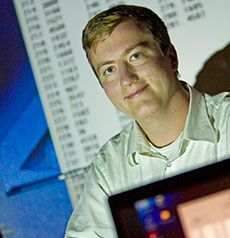
USU Computer Engineering Student Joseph Irvine
SHARE
TRANSLATE
Comments and questions regarding this article may be directed to the contact person listed on this page.


