
'Southern Paiute: A Portrait' Art Exhibition at Utah State University
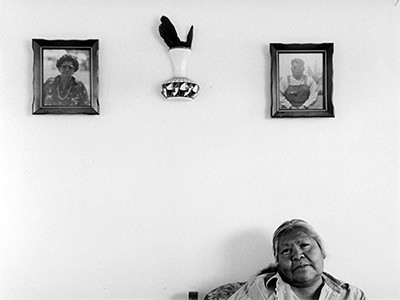
A portrait from the exhibit "Southern Paiute: A Portrait" currently showing at Utah State University's Merrill-Cazier Library. The exhibit can be seen in the library’s atrium gallery through May 29. (photo from Utah Arts and Museums Travelling Exhibition program)
University Libraries at Utah State University hosts a new travelling exhibition “Southern Paiute: A Portrait.” The limited-run exhibit is a part of the Utah Arts and Museums’ Travelling Exhibition Program.
It can be seen at Merrill-Cazier Library in the atrium gallery now through May 29.
In 2000, Michael Plyler and Logan Hebner began to photograph and interview Southern Paiute elders from throughout their homelands in the Great Basin, Colorado Plateau and Mojave Desert. And now, this exhibition celebrates the lives of 13 of these elders. Their book, Southern Paiute: A Portrait, features more than 30 interviews and portraits, representing every tribe and band from throughout the confederation in Arizona, Utah, Nevada and California.
Hebner began writing about the Southern Paiute in 1990 when the Kaibab Band on the Arizona Strip turned down hundreds of millions of dollars by refusing to allow a hazardous waste incinerator on its reservation. Impressed by the decision, he asked to see interviews with different elders. The fact that they didn’t exist was the genesis for this project.
The idea for the interviews was simple: just ask about their lives and what they thought was important. The resulting stories act as individual biographies, but together they form a collage of these people, reaching deep into their archaic past, exhibit organizers said.
Although their homeland — containing 16 national parks and monuments — is now appreciated for its beauty, until recently their deserts were considered useless, and the Southern Paiute culture survived in isolated, ignored pockets in these American deserts. As late as 1918 the San Juan Paiute still lived their ancient migration between Douglas Mesa and Allen Canyon in southeast Utah. The elders often told stories, heard from their grandparents, from before white people came into their country. Some stories reveal for the first time their perspective on controversial events such as the massacres at Mountain Meadows and Circleville, and have added understanding of these tragedies, exhibit organizers said.
“Together, the portraits and interviews paint a compelling picture of the depth of their shared history with each other and their lands, the challenges they face today and how very different their lives and culture were just one or two generations ago,” Utah Arts and Museums information said.
For more information on viewing the exhibition at Utah State University, call 435-797-0893.
Utah Arts and Museums’ Traveling Exhibit Program is a statewide outreach program that provides schools, museums, libraries and community galleries the opportunity to bring curated exhibitions to their community. The program is supported in part by a grant from the National Endowment for the Arts.
Utah Arts and Museums is a division of the Utah Department of Heritage and Arts (DHA). To enrich the quality of life for the people of Utah, DHA creates, preserves and promotes heritage and arts. The Division provides funding, education and technical services to individuals and organizations statewide so that all Utahns, regardless of race, gender, ethnicity or economic status, can access, understand and receive the benefits of arts and culture.
Information on the programs and services can be found online or call (801) 236-7555.
Related link:
Source: USU’s University Libraries/Utah Arts and Museums
Contact: Rose M. Milovich, University Libraries, 435-797-0893
SHARE
TRANSLATE
Comments and questions regarding this article may be directed to the contact person listed on this page.


