
Q&A: Earthquakes With Geophysicist Srisharan Shreedharan
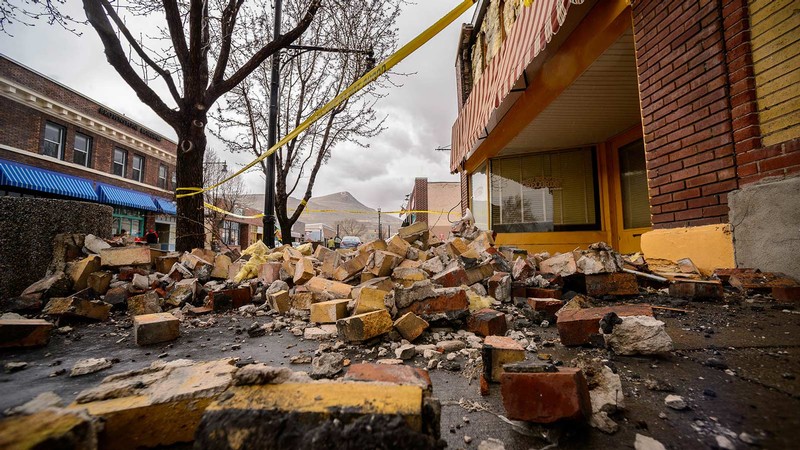
The 2020 Magna earthquake was a wakeup call for Utah. This minor seismic event caused $600 million in damage and exposed vulnerabilities across the state (Image courtesy Salt Lake Tribune/Trent Nelson).
Srisharan Shreedharan is an Assistant Professor of geomechanics and geophysics in the Department of Geosciences at Utah State University. He is broadly interested in faulting, friction and the mechanics of how earthquakes start, propagate and stop, particularly at shallow plate interfaces and in subsurface energy systems.
Q&A
Q: Myanmar and Thailand were hit by a 7.7 magnitude earthquake; could you explain how much more severe that is compared to the 5.7 magnitude quake felt along the Wasatch Front just more than five years ago?
A: Absolutely — earthquake magnitudes are logarithmic in nature, meaning that a magnitude 2 is 10 times more "severe" than a magnitude 1 and so on. In this sense a M7.7 earthquake, like yesterday, is about 100 times more severe than a M5.7 event (e.g., the 2020 Magna, Utah event). Also, these earthquakes happened in different tectonic settings — the M7.7 Mandalay earthquake was a strike-slip faulting event, whereas the M5.7 Magna event was a normal faulting event, and this together with local ground conditions and geology can profoundly affect the intensity of shaking that is experienced by local populations.
Q: The 2020 earthquake in Magna caused some minor damage to buildings and infrastructure, how would Utah handle an earthquake of greater magnitude like this recent one in Myanmar and Thailand?
A: A Utah Geological Survey study from 2016 determined that there was a 57% probability of a M6 or greater earthquake and a 43% probability of a M6.75 or greater earthquake along the Wasatch Front.
Utah has numerous buildings along the Wasatch Front that are older and/or would benefit greatly from seismic retrofitting. In this sense, it is my opinion that Utah would handle a M6+ earthquake along the Wasatch very poorly. Bills to address funding for earthquake preparedness have failed in each of the last two legislative sessions.
As it stands, we have a relatively high probability of a M6+ earthquake on the Wasatch Front in the next 50 years and we are not doing nearly enough to build resilience. In fact, we may be going backwards in some cases, without future investment from the Legislature.
Q: Why does Utah experience earthquakes? Are we on a fault?
A: Yes, there are numerous active faults in Utah. The major one is, of course, the Wasatch Fault which is an active normal fault with multiple segments, running from southern Idaho to central Utah, and 70% or more of the state's population and economy is concentrated along this high-seismic-risk corridor. In Cache Valley, we have the East and West cache faults which basically create a "bowl" shaped sedimentary basin that most of us live in. Most of the earthquakes we experience in Utah are a consequence of the extensional tectonics prevailing in the Basin and Range. Simply put, Utah is being pulled apart in the East-West direction over thousands/millions of years which creates movement along approximately North-South "tears" (or faults) in the Earth. This creates normal faulting earthquakes along these faults every 1,000 years or so.
Q: What more can be done to protect our homes, businesses and vital infrastructure from a possible major earthquake in Utah?
A: Perhaps this is a question best answered by an earthquake engineer like Prof. Brady Cox and other folks in the Utah Earthquake Engineering Research Center. My opinion is the following:
Unfortunately, earthquakes tend to be "in hindsight" hazards. Even though the public is generally well-informed when it comes to earthquakes, there's a general lethargy and sentiment that "it won't happen to me" or "it won't happen in my lifetime".
In my view, we can only build a limited degree of resilience at the scale of individual homes and businesses. Building earthquake resilience must be more systemic — governments at different levels (municipal, state, federal etc.) have to come together and increase funding — both initial and recurring investments aimed at seismic retrofits (particularly for schools and hospital buildings), ground motion studies, improved building codes especially for masonry structures, as well as for research in earthquake early warning systems.
I want to add that earthquakes are not isolated hazards — they also bring with them other secondary hazards like soil liquefaction, landslides, debris flows etc. all of which can be huge issues in Utah and greatly amplify damages.
Q: Is it true you're researching ways to possibly predict earthquakes ahead of time?
A: Yes -—this has been a longstanding problem in earthquake science. My team and I make tiny earthquakes (magnitude -1 to -7) in my lab and study their properties to understand whether there are specific signals we can look for that indicate an imminent earthquake.
Although deterministic earthquake prediction (e.g., precisely when and where and how big) is likely impossible because of how complex our planet is, I think there is a lot of room to improve early warning systems using very early geophysical signals before an earthquake, like changes in strain in the Earth. Even a few seconds or minutes of early warning can save a lot of lives.
But we need to know when and where to look for these signals and this is a profoundly difficult task — that will hopefully be made easier through the types of research we do.
CONTACT
Srisharan Shreedharan
Assistant Professor
Department of Geosciences
435-797-1273
srisharan.shreedharan@usu.edu
TOPICS
Geosciences 91storiesSHARE
TRANSLATE
Comments and questions regarding this article may be directed to the contact person listed on this page.


