
'Prehistoric Artifact Road Show' Spotlights Archeology and the Region
Utah State University’s Museum of Anthropology is taking a cue from the popular television program “Antiques Roadshow,” a traveling production that explores the antiques and cultural heritage of areas throughout the United States. At USU, archaeology experts have combined efforts for an activity designed for the residents of northern Utah and surrounding region, the “Prehistoric Artifact Road Show.”
Those who have seen the television program know the drill. Individuals bring items for evaluation and discussion. And while the USU group will not provide monetary estimates, it will provide as much background information and detail as possible. Road show experts want residents of the area to bring items — potential artifacts — to the event for evaluation, and they’re hoping to see prehistoric objects that could be as old as 11,000 years.
The event is organized by Bonnie Pitblado, associate professor of anthropology and director of the Museum of Anthropology at USU and a talented team of museum staffers, and takes place Saturday, Nov. 22. Pitblado, fellow archaeology faculty members, advanced anthropology students and museum personnel ask anyone to bring artifacts they, family members or friends have found in northern Utah or southern Idaho to the museum. A team of USU archeologists will examine the items and provide as much information as possible about their age, how they were made, and how prehistoric people used them. The review helps both sides — individuals can learn about their items and the USU team will learn about the archaeological record of northern Utah, especially Cache and Rich counties, and adjacent regions.
“We especially encourage people to bring stone artifacts like spear points — and the bigger the spear point the more likely it is to be extremely old,” Pitblado said. “The most ancient spear points lack notches of any kind and are often shaped a bit like a willow leaf or a leaf with a ‘waist’near the base. Such artifacts can be 8,000 to 11,000 years old. Really large bones and teeth are also of special interest, because they could date to the Ice Age.”
On hand at the Prehistoric Artifact Road Show will be USU experts, faculty from the anthropology program in the Department of Sociology, Social Work and Anthropology and USU students and staff from the Museum of Anthropology. All have diverse interests and work in various regions of the western United States and beyond. As a result, those attending the road show will be able to learn about nearly anything they bring, Pitblado said, whether it is a spear point, a pottery sherd, an animal bone or a mystery object.
“While the adults and those with collections chat with the archaeologists, kids of all ages are invited to hang out with a team of undergraduate students who staff the USU Museum of Anthropology every Saturday,” she said. “Museum staffers will have all kinds of cool things for kids and parents to look at and touch. There will be games and activities. We promise lots of fun for everyone in the family.”
There is more to the road show project than inspecting and providing background on items people bring to the museum. The USU team wants to learn about the very earliest residents of northern Utah and southeastern Idaho because the region has not been the subject of previous archaeological research focused on that time frame.
“Virtually nothing is known about the first people — known as ‘Paleoindians’ — who lived here,” Pitblado said. “Certainly, there were people here more than 11,000 years ago at the end of the Ice Age, and we want to learn how they made a living in the resource-rich area where the Great Basin, Plains, Columbia Plateau and Rocky Mountains were all readily accessible.”
This is a new area of research for the USU experts and will help establish a baseline of knowledge. They want to learn what kinds of early sites are present in the area — and early means sites that existed 11,000 years ago to around 8,000 years ago — what sorts of artifacts occur at the sites and whether any of the sites are candidates for excavation.
“That’s where the real fun starts,” Pitblado said. “From what we have already seen, northern Utah and southeastern Idaho enjoy a combination of resources that no other place in America does. We believe the early human record will be incredibly rich — and a whole lot of fun to study.”
Pitblado and her student team have perfected the road show routine. In summer 2008 a Prehistoric Artifact Road Show was held in Soda Springs, Idaho. Dozens of Caribou County residents attended, bringing artifacts they found in their fields, on their ranches, around springs and elsewhere. The archaeological team learned about several very ancient sites from the attendees, ultimately identifying in just one summer 57 sites in southeastern Idaho that are 8,000 or more years old, many of them with potential for future study and excavation.
Pitblado has taught archaeology at USU since 2002, and she has worked in the field at Paleoindian sites for more than 15 years. Her field work has taken her across the western United States with most of her research of the past decade conducted in the high mountains of southwestern Colorado. She is excited at the prospect of shifting her focus closer to USU and conducting field research in northern Utah and southern Idaho.
Pitblado and the student team were joined in Soda Springs by Emily Jones. A new USU faculty member, Jones is a zooarchaeologist who studies animal bones from archaeological sites to understand the relationship between ancient people and the environment. She is an expert in the analysis of small animal bones and has already seen some bones from this area.
“It looks like I am going to have to bone up on the really big guys, like extinct forms of ice-age bison and mammoths,” Jones said. “I have already seen a lot of very old, very large animals here.”
Jones joined the faculty at USU in 2008 and serves at the Brigham City campus. She received her doctorate from the University of Washington in 2004.
Pitblado and Jones want to establish a long-term research and field school program in northern Utah and southeast Idaho that actively engages USU students in all phases of the archaeological research process. The missing element is identifying very ancient sites for the work on the Utah side of the border, and that’s where the Prehistoric Artifact Road Show comes in.
“We know from the private contacts we already have that there are great Paleoindian sites in Cache and Rich counties, but not a single one has yet been documented by an archaeologist and made its way into the central archaeological site database for the state of Utah,” Pitblado said.
The Prehistoric Artifact Road Show team hopes to change that and identify potential Paleoindian sites from those who attend the road show.
“We’ll only learn about the sites from people who spend time on the land — farmers, ranchers, hunters, fishermen, hikers, sportsmen of all stripes — who tell us about them and share what they’ve found through the years and the generations,” Pitblado said. “This is how I learned of all the most exciting sites I excavated in Colorado. It is how we identified 57 Paleoindian sites in southeastern Idaho and it is how we will learn about the northern Utah Paleoindian record too.”
She and her team of student researchers want to know what people were doing in this area 10,000 years ago.
“And, we want to share the job of discovering that with our friends and neighbors here at home,” Pitblado said.
In addition to the field school work, the Department of Sociology, Social Work and Anthropology has implemented a new master’s degree program in archaeology, with its first class arriving on campus in fall 2009.
“Together with our talented undergraduate anthropology majors, we envision many of our new master’s students studying elements of the archaeological record in northern Utah and southeast Idaho and helping us piece together the region’s prehistory,” Pitblado said. “Some of the students have interests in time frames that post-date the Paleoindian era, so in the long run, we will learn about not just the most ancient residents of the region, but more recent folks as well.”
If you want to attend the Prehistoric Artifact Road Show:
When: Saturday, Nov. 22, 11 a.m. to 3 p.m.
Where: Utah State University, Museum of Anthropology, Old Main, Room 252
Bring: prehistoric artifacts, including arrowheads, spear points, pottery, stone and bone tools, and anything else you want to learn about
Parking: Free parking is available Saturday in the lot immediately south of Old Main
Admission: Free
For information, contact the Museum of Anthropology (435) 797-7545
Related links:
- Museum of Anthropology
- Anthropology Program
- Department of Sociology, Social Work and Anthropology
- College of Humanities, Arts and Social Sciences
Contact: Bonnie Pitblado (435) 797-1496, bonnie.pitblado@usu.edu
Writer: Patrick Williams (435) 797-1354, patrick.williams@usu.edu
Writer: Patrick Williams (435) 797-1354, patrick.williams@usu.edu

These spear points are more than 8,000 years old. If you have similar items, USU professor Bonnie Pitblado and a team of USU faculty and students would like to see them at the Prehistoric Artifact Road Show Saturday, Nov. 22, at USU.
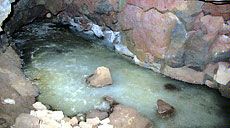
An ice cave in southeastern Idaho, a site surrounded by prehistoric artifacts, including some more than 9,000 years old. A local couple shared the site with the USU researchers. It is on land they've farmed for years.
SHARE
TRANSLATE
Comments and questions regarding this article may be directed to the contact person listed on this page.


