
Plant Biologist Offers Inaugural Lecture
As a young teen, Paul Wolf received a school report that described him as "unfocused and easily distracted."
Wolf, who joined the faculty of USU's biology department in 1992, conceded that he is easily distracted. "Curiosity continually drives me," he told family, friends and colleagues who joined him Nov. 3 at the President's Home for the fourth talk in the university's 2005-06 Inaugural Professor Lecture Series. The series highlights the accomplishments of university faculty who have been promoted to full professor in the past year.
But whether or not Wolf is unfocused may be in the eye of the beholder. He recalled an incident in secondary school in his native England, where he was a member of the reception committee preparing for a visit from Prince Charles.
"I was also an avid member of a bird watching group that was continually on the lookout for the return of resident species," said Wolf, who explained that a number of resident bird species in England were killed off during the harsh winter of 1962-63.
Lo and behold, an elusive bluethroat was spotted near campus and Wolf rushed off to watch for it. He completely forgot about the royal visit.
"My headmaster was not happy," said Wolf.
Try as he might, Wolf simply couldn't make his headmaster understand that seeing a bluethroat was a much rarer and more significant opportunity than meeting a blueblood.
"I guess I knew then that I was doomed to academia," said Wolf.
He entered the University of Leicester, where he decided to pursue botany rather than zoology because the former promised a field trip to Mallorca.
"I was looking forward to sunny beaches, discos and cheap wine," admitted Wolf.
Once ensconced in the popular Mediterranean tourist destination, however, Wolf spent most of the trip hunched over a dissecting scope. Thus began his shift in focus from animals to plants.
Today, Wolf's research is focused on DNA sequencing and how plant genes and genomes evolve over long periods of time. He's involved in a National Science Foundation-funded project called the "Tree of Life," which seeks to depict how all organisms are related.
"This is not a trivial task," said Wolf.
As part of the project, Wolf is focused on the collection of developmental, morphological and genomic data of green plants. "Green plants are among the most well understood organisms and we can apply the principles we've learned from these plants to other parts of (the Tree of Life)," he said.
Most of Wolf's current efforts involve looking at chloroplast genomes and watching for changes, including particular divergent events. These changes may or may not be associated with evolutionary adaptation. Wolf and colleagues suspect not.
"They may simply be rare events that indicate common ancestry, much like backbones indicate that all vertebrates share a common ancestor," said Wolf.
Wolf was named a USU Mortar Board Top Professor in 1998. He earned a bachelor's degree in biological sciences from the University of Leicester and a master's degree in botany from the University of Kansas. He completed a doctoral degree in botany at Washington State University and postdoctoral studies at the University of California, Irvine. He has published numerous peer-reviewed journal articles and book chapters.

Paul Wolf was featured in the Inaugural Professor Lecture Series at Utah State University.
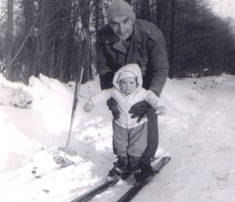
Paul Wolf (at about 18 months) and his Austrian-born father enjoy rare skiing during England's record cold winter of 1962-63. Paul says he inherited his father's love of mountains and nature.
TOPICS
Inaugural Lecture 130storiesSHARE
TRANSLATE
Comments and questions regarding this article may be directed to the contact person listed on this page.


