
Olsen Chemistry Lecture Features Norman Dovichi
As part of the Richard Olsen Lecture Series, Utah State University’s Department of Chemistry and Biochemistry welcomes renowned analytical chemist Norman J. Dovichi to campus Wednesday, Nov. 28.
Dovichi, endowed professor of analytical chemistry in the University of Washington’s Department of Chemistry, presents “Chemical Cytometry – The Analysis of a Single Cell.” He speaks at 4 p.m. in the Eccles Science Learning Center, room 046. His talk is free and open to all.
Dovichi was named an Unsung Hero of the Human Genome Project by Science in 2001 for his development of genome mapping technology that greatly advanced the project.
Lecture host Stephen Bialkowski says Dovichi has a long list of accomplishments, but one of his most significant was being the first to observe molecules in laser-excited fluorescence.
“He used this technology to demonstrate how one could look at the enzyme kinetics of individual enzyme molecules,” says Bialkowski, professor in USU’s Department of Chemistry and Biochemistry. “This method, now commonplace, allowed him to address one of the big questions in the heterogeneity of enzyme kinetics. With an elegantly simple experiment, he was able to show that variations in enzyme kinetic rates were due to variations in individual enzyme molecules.”
Dovichi’s current research uses similar technology to characterize compositional changes that accompany Barrett’s esophagus, a precancerous condition. Gastroesophageal cancer is a leading cause of cancer death worldwide and one of the most rapidly increasing forms of cancer in the U.S.
Among Dovichi’s many awards and honors are the 2007 Ralph Adams Award in Bioanalytical Chemistry, the 2003 Spectrochemical Analysis Award, the 2000 Heinrich Emanuel Merck Award for Analytical Chemistry and the 1996 Chemical Instrumentation Award from the Analytical Division of the American Chemical Society. He has published more than 200 academic papers and hold seven patents.
Dovichi’s appearance is the second lecture of the Richard Olsen Lecture Series, which was established in 2006 by USU Emeritus Professor Richard Olsen and his wife, LaVina Hymas Olsen. The lectureship was established in honor of Olsen’s parents, Kenneth Beal Olsen and Sarah Young Olsen, who, Olsen says, “made many things possible.”
Olsen says the lectureship was also established in appreciation to the Department of Chemistry and Biochemistry and to Utah State for providing him the opportunity to pursue his professional goals of teaching and research in the field of organic chemistry.
During Olsen’s distinguished career at Utah State, which spanned more than three decades, he received research grants from a number of prestigious agencies, including the National Institutes of Health. Olsen authored nearly 60 articles in peer-reviewed journals and mentored numerous undergraduate and graduate students.
Parking for the lecture is available in the USU parking terrace at 700 E. 600 North. The parking terrace is within short walking distance of the Eccles Science Learning Center.
For more information about the lecture, contact USU’s Department of Chemistry and Biochemistry at 435-797-1619.
Related links:
Contact: Stephen Bialkowski, 435-797-1907; stephen.bialkowski@usu.edu
Writer: Mary-Ann Muffoletto, 435-797-1429; maryann.muffoletto@usu.edu

Analytical Chemist Norman Dovichi is guest speaker for USU's Richard Olsen Lecture Series Wednesday, Nov. 28. Photo by Mary Levin, courtesy of the University of Washington.
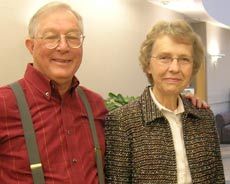
USU Emeritus Professor Richard Olsen and his wife, LiVina Hymas Olsen, established the Olsen Lectureship to provide Utah State students and faculty with opportunities to learn from and meet with distinguished chemists.
SHARE
TRANSLATE
Comments and questions regarding this article may be directed to the contact person listed on this page.


