In his writings and speeches, the late Kermit Hall, USU president from 2001-04, often referred to the distinct benchmark left by ancient Lake Bonneville that edges Utah State University’s Logan campus. He used the landmark as a metaphor to describe the university’s strong foundation, crafted by efforts of pioneering visionaries, and the institution’s aspirations for continually higher standards of excellence.
This week [Jan 26], Aggies and local residents have the opportunity to learn more about the mysterious geological formations that lay beneath Utah’s land-grant university with the opening of the USU Luminescence Geochronology Laboratory on Utah State’s Innovation Campus. The Cache Valley community is invited to an open house Friday, Jan. 26, from 4-7 p.m. at the new facility, which is located at 1770 North Research Park Way, Suite 123, in North Logan.
Managed by the College of Science’s Geology Department, the new lab features cutting-edge capabilities in optically stimulated luminescence or “OSL” geochronology that enable geologists, archaeologists and other scientists to accurately determine the age of sediment samples.
The lab’s first assignment? How about determining the age of the USU campus? No, not the date the university was established – which was 1888 – but the actual age of the ground upon which Aggies walk.
“One of the primary challenges in earth science has always been understanding the dimension of time – how old a canyon is, how long it takes to build a mountain range, how often earthquakes happen,” says Joel Pederson, associate professor of geology and director of the new lab. “I think it’s fitting that the very first age determination performed in the new lab is on the geologic material that forms Utah State University’s foundation.”
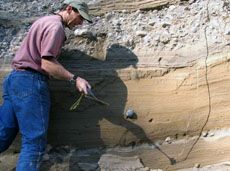
In September 2005, a landslide overlooking Logan’s Island neighborhood just south of the university quad exposed an inner section of the Lake Bonneville benchmark. While citizens and local authorities fretted about the mishap’s implications for life, limb and property, USU geologists scrambled to collect precious samples.
“Ancient Lake Bonneville was around for a long time, so as we examine the deposits we have to ask, ‘To what lake level stand do they belong?’” says Pederson. “And when did they occur during that stand?”
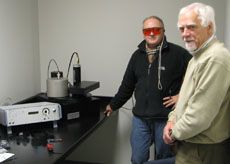
The lab’s core instrument, which was funded by a grant from the Val A. Browning Foundation, is a luminescence reader developed by Denmark’s renowned Risø National Laboratory. About the size of a personal computer, the reader uses controlled doses of radiation and light to incite and measure the responding light, or luminescent glow, of sand grains and thus determine their age.
Pederson says recent technical advances in luminescence dating make it one of the most powerful, accurate and cost-effective methods for solving geological problems. It offers a number of advantages over conventional methods such as radiocarbon and cosmogenic dating of young geologic samples. Both of these older methods are difficult and costly, he says, which means neither is conducive to student research.
“I’m always looking for ways to involve students in research,” Pederson says. “The new lab offers great opportunities for undergraduates and grad students to learn about luminescence dating and conduct projects on their own.”
Pederson says only a handful of similar labs are located in the United States.
“The U.S. is somewhat behind in this technology,” he says. “More labs are currently found in Europe and India.”
Prior to the Utah State lab’s opening, Pederson was sending samples from USU to out-of-state facilities.
“I thought, ‘Why use our precious research funding to send samples and students somewhere else when we could be doing the work here?’”
He envisions the USU lab having a regional focus and primarily serving Intermountain students and scientists, though it already has clients in Thailand and Alaska.
“We already have a six-month backlog in projects,” he says. “The time and effort we devote to measurement of external samples will help fund the ongoing operations of the lab.”
Don Fiesinger, dean of USU’s College of Science, says the university is grateful to the Browning Foundation for funding a facility than enhances hands-on learning.
“The lab encourages innovative research opportunities for students at all levels of their academic careers.”
All members of the community are invited to guess the age of the lab’s campus sediment samples and place their answer in a ballot box in the Geology Department office in room 205 of the Geology building. Results of the lab’s dating of the samples will be revealed at the Jan. 26 open house. Prizes will be awarded to the contest entrants who supplied the three closest guesses.
Related Links:
Writer: Mary-Ann Muffoletto [
maryann.muffoletto@usu.edu]; 435-797-1429