
Inspirational Native American Spiritual Leader to Speak at USU
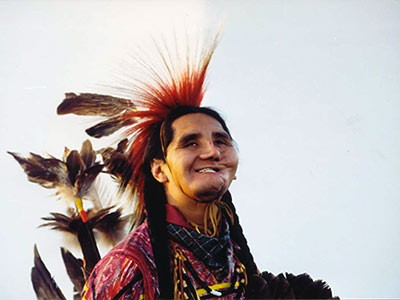
Arnold Thomas, a Native American who is a member of the Shoshone-Paiute Tribal Nations of the Great Basin in the Western United States, and attempted suicide survivor is the keynote speaker during a three-day event at USU titled "Finding Balance: A Native American Perspective."
Arnold Thomas found balance long after an early life that was sent spiraling off kilter following a suicide attempt. When he was 18, Thomas placed a hunting rifle under his own chin and fired. He was permanently blinded and disfigured, unable to speak for several years, but he lived. And Thomas, a Native American who is a member of the Shoshone-Paiute Tribal Nations of the Great Basin in the Western United States, charged with a newfound respect for life, lived with purpose.
For three days, April 20-22, Utah State University’s Access and Diversity Center, in partnership with the College of Humanities and Social Sciences’s departments of Sociology, Social Work, and Anthropology; Religious Studies; and the College of Education department of Psychology, will present a series of events titled “Finding Balance: A Native American Perspective,” with Thomas as the program’s keynote speaker.
Thomas first attended a school for the blind in Salt Lake City while also retraining himself to talk. In time, he acquired a master’s degree in social work while also immersing himself in the study of Native American spiritual practices. He was ordained a “Holy One” in 2011.
Now spending much time as a motivational speaker, Thomas also serves as spiritual advisor for the Salt Lake City Veteran’s Administration Hospital and received national certification as the first chaplain in the American Indian tribal faith traditions. His keynote address at USU is from 6-8 p.m. April 21 in the Taggart Student Center East Ballroom, where Thomas will discuss maintaining in life what Native Americans refer to as the medicine wheel or sacred hoop. The elements needed to keep the wheel in balance are physical, emotional, mental and spiritual.
Thomas’ address is free and open to the public. Refreshments will be served. The evening included poetry, song and traditional dance by Native American USU students.
Other events included in the Finding Balance: A Native American Perspective program include:
- Monday, April 20, 7-9 p.m., Taggart Student Center auditorium, free film screening of “Healing the Warrior’s Heart,” which explores how Native American ceremony is helping both Native and non-Native veterans cope with PTSD. Arnold is featured for his work with Salt Lake area veterans.
- Wednesday, April 22, 9:30-10:30 a.m., Distance Education 012 (only 40 seats available, arrive early), lecture, “Culturally Relevant Interventions for PTSD,” sponsored by the USU Department of Psychology.
- Wednesday, April 22 (Earth Day), 8-9 p.m., Distance Education 013 (75 seats available), lecture by Arnold Thomas, “Loving Mother Earth for Seven Generations: Native American Spirituality and Social Work.”
Admission to all events is free and open to the public.
More information about Arnold Thomas is online.
For more about any of the events scheduled during “Finding Balance: A Native American Perspective,” contact Angela Enno, angela.enno@usu.edu.
Writer and contact: Kristin Middaugh, kristin.middaugh@usu.edu
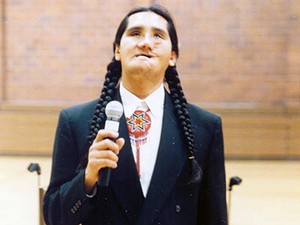
Arnold's visit and the symposium are sponsored by a number of USU departments, programs and offices. His keynote address is Tuesday, April 21, 6 p.m., Taggart Student Center East Ballroom. The public is invited.
SHARE
TRANSLATE
Comments and questions regarding this article may be directed to the contact person listed on this page.


