
Getting into India
By: Steve Shinney, The Utah Statesman, October 24, 2005
Saturday evening [Oct. 22], the TSC Ballroom was transformed into a little bit of India as the Indian Student Association put on Diwali 2005.
"I feel like I'm in India right now," Abinash Bhattachan, a senior in watershed science from Nepal and the president of the International Student Council, said. "The culture is so rich and it's amazing that they could take their culture and carry it to foreign soil and carry it so well."
Bhattachan said that the ISC had very limited involvement with the planning and production of Diwali, saying that it was all done by the ISA. He also commended those involved with the event on their success.
The event consisted of a traditional Indian dinner, and the night was hosted by Shounak Krishnanand and Jaya Prabha, both from India.
In India, Diwali, or the festival of lights, is a highly anticipated event among all the nation's peoples, regardless of religion.
The evening began with a traditional candle-lighting ceremony, in which Logan Mayor Doug Thompson lit several candles in a golden holder on the front [of] the stage.
"Everywhere but in America, the mayor is really hot stuff," Mayor Thompson said. "It's very common for them to invite local officials to participate."
Thompson spoke highly of the event as a whole. "It's incredible; we've always enjoyed this. It's our third year coming and we always look forward to it."
But the night was not just about India. Christine Dhiman, 16, from Logan High School, performed a "fusion" dance, in which she showed a combination of Indian and American culture. During the dance, she wore an outfit with green, white and orange - the colors of the Indian flag -in front, with the traditional American red, white and blue on her back.
"I wanted to project myself as an Indian woman and as an American woman so that I could combine both cultures," said Dhiman, who both choreographed the dance and made the costume herself.
Indian Oven, a local Indian restaurant, provided the food which included chicken tikka masala, a mild chicken curry; tandoori chicken with rice; naan bread and mango lassi to drink. The food was served by Indian Oven employees and volunteers to guests during intermission.
"Some of [the food] is really good," Kat Duhadway, a senior in computer science attending her first Diwali, said. "It's a totally different base than American food."
Several group dance numbers were presented to the audience.
One such dance was the Garba dance, from Gujarat, the westernmost Indian state that, according to www.gajaratindia.com, the state's official Web site, is the business state of India.
During the Garba dance, five couples spun to the music and the rhythmic clapping of the crowd. The men were dressed in long shirts and loose pants of various colors and large bandanas tied around their heads. The women were wearing traditional dresses from the area. About halfway through the dance, performers took out sticks and beat them together in time with the music.
"The Gujrut dance was the best part," John Crockett, a graduate student in electrical engineering, said. "It was very upbeat and colorful."
Several Bollywood style dance numbers were also performed. According to www.bollywoodworld.com, Bollywood refers to a kind of Indian filmmaking based out of Mumbai, India (formerly Bombay), in which singing and dancing play major roles.
As in years past, this Diwali included a rendition of the traditional tale of Ramyana, which, according to the event's hosts, is a story from north India in which King Rama returns after 14 years of exile to defeat the demon king who had kidnapped his wife.
This year, however, they attempted to give a more modernized version of the classic tale.
In this version, the story took place in Logan, the wilderness that Rama was banished to was Wyoming and the demon realm was located in Provo.
Near the end of the night, Charles Mallela, a graduate student in computer science, took the stage to sing.
Mallela sang four songs throughout the night and even received an award at the end for all his service at Diwali over the last four years. "It was awesome. It was a great honor."
Mallela said that his favorite song was "Woh Lamhe."
"It's a love song," Mallela, who also help choreograph a few of the group dance numbers, said.
-steveshinney@cc.usu.edu
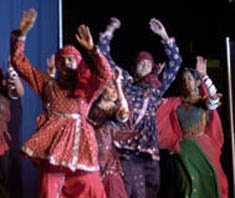
Media Credit: Michael Sharp. Dancers perform the Garba a traditional dance from western India.

Media Credit: Michael Sharp. Food for Diwali was supplied by local restaurant Indian Oven. Several traditional Indian dishes were available, including chicken tikka malsa and tandoori chicken.
SHARE
TRANSLATE
Comments and questions regarding this article may be directed to the contact person listed on this page.


