
Former Utah State Student Shines at Paralympics
Thatcher, Utah, native Marlon Shirley has long dreamed of becoming a pilot. After mentioning his ambition to a high school advisor in Washington, where he’d gone to pursue specialized track and field training, Shirley was asked, “Have you ever heard of Logan, Utah? Utah State has a great program in aviation technology and professional pilot training.”
Shirley eventually made his way back to northern Utah and enrolled at Utah State in the fall of 2001. But after two semesters his dream was put on hold, while the superstar sprinter of the 2000 and 2004 Paralympics chased another ambition – a professional career as an elite disabled athlete.
Shirley, who lost his left foot in a lawnmower accident at age 5, is the first leg-amputee to run the 100-meter dash in less than 11 seconds – clocking a scorching 10.97 at the 2003 Utah Summer Games. He also holds the world record of 6.79 meters in the long jump. In Athens last month, Shirley captured his second gold medal in the 100 meters, defending his previous win four years ago in Sydney. In addition to his gold, he won silver in the 200 meters and earned a bronze in the long jump.
“It’s hard to put the whole Paralympics experience into words,” said Mary Shirley, Marlon’s sister who currently attends Utah State. “I mean, I was watching my own brother at the starting line, and my heart was just going so fast.”
Mary made a last-minute decision to accompany her parents, Kerry and Marlene, to Greece to watch her brother compete. “Marlon was recovering from a hamstring injury, and we weren’t sure he’d be participating until about three weeks before the games,” she said.
Worried about starting a new semester and keeping up with schoolwork, Mary said she hesitated before accepting Marlon’s invitation to travel to the games. “Then I thought, ‘I’d be insane if I didn’t go. It’s the chance of a lifetime.’”
She caught herself “screaming at the top of my lungs” as she watched Marlon, who races with a high-tech carbon fiber prosthesis, sail to the finish line.
“I always make fun of my mom about losing her voice at Marlon’s races, and there I was caught up in the excitement.”
Marlon reinjured his hamstring during the games but managed 6.20 meters in the long jump. “He still won the bronze. That’s just Marlon,” said Mary.
His injury forced him to drop out of the 4x100 and 4x400 relays, which his sister said was “bittersweet.” Marlon didn’t want to let his team down, but the injury afforded him an extra day to cruise the islands and relax with his family. Her brother’s growing celebrity leaves little time for rest, said Mary.
Now 26, Marlon trains full-time with able-bodied runners at an Olympic training facility in Chula Vista, Calif. He’s one of a small group of disabled athletes who earn their living from corporate sponsors. Marlon’s list of sponsors includes prostheses manufacturer Ossur, as well as more recognized companies McDonalds, Visa, Reebok, Oakley sunglasses and Gateway computers.
What makes Marlon’s story all the more amazing are the precarious obstacles he faced early in life. As a preschooler, he was taken from his birth mother by Nevada authorities and placed in an orphanage, where the mower accident occurred. He suffered physical abuse while living in foster care and was adopted years later, at age 9, by the Shirley family.
“I remember traveling to Nevada to meet Marlon,” said Mary, who was three years old at the time.
She said Marlon “just fit right in to our family,” which also includes sister Keri Beth, 27, and brother Tim, 25.
“It’s funny —people look at Marlon and I and say they can see the family resemblance,” said Mary, with a good-natured gleam in her green eyes that mirror those of her African-American brother.
Major U.S. networks didn’t broadcast the 2004 Paralympics, but Outdoor Life Network (OLN) will air highlights of the Athens games, along with a feature about Marlon, Nov. 13 and 17. Check local listings for times.

Sprinter Marlon Shirley celebrates in Athens with mother, Marlene Shirley (left), sister, Mary, and father, Kerry Shirley. Marlon attended Utah State in 2001 and Mary is currently a student. Photo courtesy of Mary Shirley.
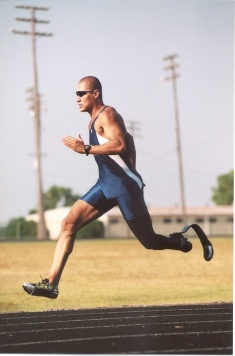
Paralympic gold medalist Marlon Shirley is the first amputee to run the 100 meter dash in less than 11 seconds. Photo courtesy of Ossur.
SHARE
TRANSLATE
Comments and questions regarding this article may be directed to the contact person listed on this page.


