
Former Dean of Science Receives Outstanding Graduate Mentor Award
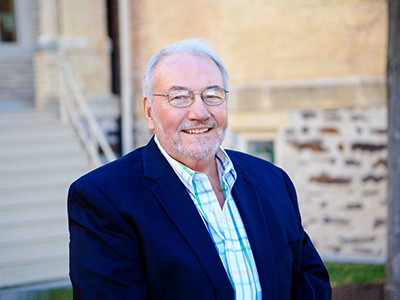
James MacMahon, Utah State University's 2015 Graduate Mentor of the Year.
James MacMahon, trustee professor of biology and former dean of the College of Science, is Utah State University’s 2015 Outstanding Graduate Mentor of the Year.
In MacMahon’s 52-year career, 44 of those years have been in service to Utah State University. During this time, MacMahon has mentored more than 60 graduate students, who today credit his varied biological interests and knowledge, professional appointments and personal investment in each of his students as contributors to their own successful careers.
“MacMahon always seemed interested in what his graduate students were doing and encouraged us to work on projects outside of our doctoral research,” said Kimberly Smith, professor of biology at the University of Arkansas, Fayetteville. “He was always there to discuss an idea.”
MacMahon’s encouragement to pursue scientific study outside his students’ research topics mirrored his professional practice. His own extraordinary breadth of interests has included herpetology, mammalogy, entomology and botany. His work also focused on the functioning of desert ecosystems and montane forests and the recovery of populations from catastrophic ecological change — primarily as evidenced by the aftermath of the eruption of Mount St. Helens.
What has made MacMahon distinct is his custom to take these interests beyond books and the lab and out into the field.
“Jim was not only an excellent scientist but also a remarkable naturalist, whose familiarity with diverse taxa is unmatched in my experience,” said John Mull, professor of zoology at Weber State University. “Time in the field with Jim was special. Some outings were centered on a course or research project, others were solely for exploration in and exposure to new systems.”
MacMahon believes that his students should view their training process in graduate school as more than simply vocational training, but as a broader preparatory measure for the quality of their future scholarship.
“Graduate degrees in biology prepare students for diverse careers in academia, governmental agencies and the private sector, but they will encounter intense competition for any such positions,” said MacMahon. “The quality of their graduate experience is a critical element in determining their professional success.”
And, his students have found that professional success. Many of them currently hold positions with research universities, the U.S. Forest Service, the U.S. Fish and Wildlife Service, the U.S. Environmental Protection Agency and Australia’s Commonwealth and Industrial Research Organization.
Students who reflected on MacMahon’s mentoring note the social relationships he fostered between them and himself, other leading scientists and their peers.
Beyond formal lab meetings, MacMahon maintained an openness and hospitality with his graduate students, understanding the importance of personal and professional connections.
“A strong network of colleagues is essential to all professional biologists, and helping a student to develop their own such network is an important element of training,” MacMahon said.
Former students echoed the value of this networking.
“Informal gatherings were convened at Jim’s house, where he and Patty would host his students, their partners and select friends and colleagues three or four times a year,” Mull said. “They did this at their personal expense, plying us with good food and drink. In retrospect, I appreciated the critical role these get togethers played in cementing the bond that Jim sought to form not only with his students, but also among them. To this day, some of my closest personal and professional relationships are with members of my MacMahon lab cohort.
MacMahon took seriously the responsibility of his role.
“Robust graduate training in the biological sciences ultimately requires apprenticeship to a fully engaged and professionally accomplished mentor,” he said.
MacMahon’s extensive engagements include prestigious positions, including president of the Ecological Society of America, chairman of the Board of the National Observatory Network and service on the advisory board of NASA’s Jet Propulsion Laboratory and the board of directors of the Utah Nature Conservancy.
In his 52-year career, MacMahon’s list of accolades includes both USU’s D. Wynne Thorne Career Research Award — USU’s highest research honor — and the Leone Leadership Award. Additionally he received the distinguished service award from the Ecological Society of America and was elected as a fellow of the American Association of the Advancement of Science.
“All of this evidences that Jim has exceed his own standard of engagement and accomplishment to earn this honor of Outstanding Graduate Mentor of the Year,” said Mark McLellan, USU vice president for research and dean of graduate studies. “Quite simply, Jim is an icon at Utah State University.”
MacMahon will be recognized at USU’s Research Gala April 6 at the Riverwoods Conference Center. The gala opens this year’s Research Week, featuring lectures, symposia and other events highlight faculty and student research at Utah State University. For more information, see the research week website (researchweek.usu.edu).
Related link:
USU Office of Research and Graduate Studies
Contact: Mark McLellan, 435-797-1180, mark.mclellan@usu.edu
Writer: Emily James, emily.james@usu.edu
SHARE
TRANSLATE
Comments and questions regarding this article may be directed to the contact person listed on this page.


