In many cases, Utah State University’s Nora Eccles Harrison Museum of Art is the first exposure to art students living in northern Utah may have. Making art accessible and offering personal experiences with modern and contemporary art objects is central to the museum’s mission.
Examining contemporary issues and art-making specific to the American scene in the western United States give a certain flavor to the experience. Contemporary art, although exciting, can be challenging to understand, so to help its audience find meaning, and to serve as a resource for teachers and students of all kinds, the museum has developed extensive education programs.
Early exposure to art and outreach to underserved populations make the museum’s K-12 education programs fundamental to building art appreciators for the future and to the museum’s youth programs. The museum’s education personnel are committed to developing resource information for classroom teachers, and one was recognized for her dedicated efforts.
Nadra Haffar, education curator at the Nora Eccles Harrison Museum of Art, has been named the state’s Art Educator of the Year. Make that years.
Haffar was named Outstanding Museum Educator of the Year 2007-08 and Outstanding Museum Educator of the Year 2008-09 by the Utah Art Education Association at its annual conference.
“Many public school teachers are frightened and intimidated or even ill-prepared to incorporate the arts into the curriculum,” Haffar said. “Through my work at the museum, I feel it is my role to help with the process.”
At Utah State, Haffar works at all levels in the educational world and with a variety of groups that visit the museum, ranging from children to adults.
“The curator of education is responsible for developing and supervising the docent program, planning educational events and public activities for the museum,” said Victoria Rowe, the museum’s director and chief curator.
During the academic year 2006-07, more than 7,000 students came to the museum. Of those, 950 were public school students in 35 different groups.
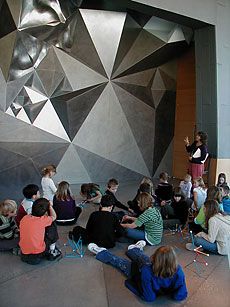
Among those groups was a second-grade class from Edith Bowen Laboratory School and its teacher Marianne Christian. An educator with more than 13 years experience, Christian said she takes full advantage of the resources offered at USU. She brings her students to campus four to five times a year for a multitude of experiences. Her class visited the new Performance Hall during a session on zone tools. The students used the Performance Hall’s sculpture “Passacaglia” to study repeating patterns.
“The idea is to give the students a broader experience,” Christian said. “The classroom is small, and I like getting the students out. It’s just like adults who travel. The more you travel, the more open you are to new ideas and new experiences. Our fieldtrips provide these experiences.”
Building educational partnerships is important at the museum.
“We want to help make the connection between what they are studying and art,” Haffar said. “We get to build strong relationships with the teachers at all levels.”
Christian feels especially connected to Haffar and the museum via the new ArtsBridge program and its USU director, Laurie Baefsky.
In the fall of 2007, Utah State became the 23rd university in the United States to host an ArtsBridge America program. Through the Caine School of the Arts and the College of Humanities, Arts and Social Sciences, USU ArtsBridge provides service-based instructional scholarships to qualified university students and hands-on, long-term arts residencies in classrooms for K-12 students.
With its proximity to campus, the museum has a close relationship with Edith Bowen Laboratory School, as well as associations with the Logan City and Cache County school districts. It also works with nontraditional groups, including disabled adults, at risk youth and residential treatment facilities.
“These hands-on experiences really impact the students,” Christian said. “Nadra is very involved with what the children are doing. She is very professional and is clearly excited about what she does.”
At USU’s museum, tours arranged and scripted by Haffar include hands-on activities that connect the experience to the theme or the artist the group is studying. However, it is most important that the students experience this in the atmosphere of the museum — not the classroom at their individual schools.
Haffar notes that the pendulum of including the arts in the curriculum — no matter how you define the arts — will continue to swing.
“But I think it is coming back,” she said. “Math and science are included in the arts, we just have to show how they are included in a creative way. As an art educator, I need to find the keys to let students discover how other disciplines are involved or related. I always enjoy hearing young students on tours say, ‘I’m so glad I got to come today. I’m missing math,’ and I get to say, ‘Oh no you’re not, you are doing math right now,’ and explain or show how.”
“I appreciate Nadra’s engagement with our young guests,” Rowe said. “She is dedicated to reaching these moldable, young minds — trying to inspire them about the world around them and the fuzziness of the divisions between art, science and all learning. Her philosophy is dynamic. Many things lead to paths of learning — but all paths lead to art.”
May 2008