
Entomologist Presents Inaugural Lecture
As a child growing up in southern California, Diane Alston enjoyed tagging along on her teacher father's junior high science field trips to the ocean shore and points beyond. Her favorite destination was the Corona del Mar tidepools near Long Beach, where she delighted in the colorful variety of marine animals and plants. "I wondered how so many different plants and animals could exist in such a harsh environment," she recalls.
Alston, who joined the faculty of USU’s biology department in 1989, said she initially dreamed of becoming a marine biologist. “But faculty mentors cautioned that job opportunities in the field were few and far between,” she told family, friends and colleagues who joined her Nov. 8 at the President’s Home for the fifth talk in the university’s 2005-06 Inaugural Professor Lecture Series. The series highlights the accomplishments of university faculty who have been promoted to full professor in the past year.
After completing undergraduate studies at University of California, Riverside, Alston headed to the opposite side of the country - North Carolina State University – to continue her academic pursuits. Though she wasn’t raised on or near a farm – “I didn’t have agriculture in my upbringing,” says Alston – she became interested in entomology and crop protection.
“I was 23 or 24 years old before I took my first entomology class. Work in a plant hematology lab opened my eyes to the importance of agriculture,” she says. “We rely so much on plants for our lifestyle.”
Alston’s interest in integrated pest management or “IPM” grew and she eventually earned a doctorate degree in the field. “It was the niche I was meant to fill,” she says.
IPM, says Alston, is a concept of trying to protect plants from all different types of stresses, including insects, pathogens, nematodes and weather. Biorational approaches to provide a broad range of viable alternatives to harmful pesticides, she says. Such approaches use a combination of insect growth regulation, conservation of biological agents and application of microbial insecticides, as well as insect attractants and repellents to affect insects’ communication systems.
Talking with growers on the front lines of agriculture, Alston realized that she must venture beyond the research arena and provide practical solutions. Her work at USU, where she has both a research appointment and an Extension appointment as an entomology specialist, is “the ideal job for me.”
Alston considers her work with the 17-year-old Utah Tree Fruit Program among the highlights of her career. “Our goal has been to provide growers with viable alternatives to heavy pesticide use,” she says. “We’ve really seen dramatic changes in how growers approach pest management.”
Alston is encouraged by the evolution of Extension, which is changing to meet the increasingly urban needs of Utah. “Extension provides unique opportunities to share knowledge,” she says. “The people of Utah should have free access to information that will improve their lives.”
Alston’s current research endeavors include a USDA-funded reduced risk pest management program for U.S. tart cherry production, along with a USDI-funded threatened and endangered plant pollinators project in Capitol Reef National Park.
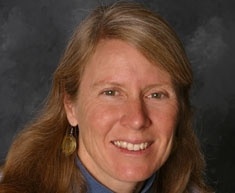
Diane Alston, inaugural professor
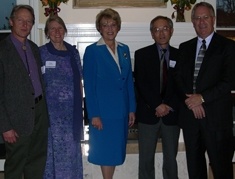
Inaugural Professor Diane Alston, second from left, poses with her husband, Clifton, left, and First Lady Joyce Albrecht, Biology Department Head Jon Takemoto and President Stan Albrecht at her inaugural lecture held Nov. 8 at the President’s Home.
TOPICS
Inaugural Lecture 130storiesSHARE
TRANSLATE
Comments and questions regarding this article may be directed to the contact person listed on this page.


