
English Prof Probes 'Ordinary Trauma' in Her Life, That of Artist O'Keeffe
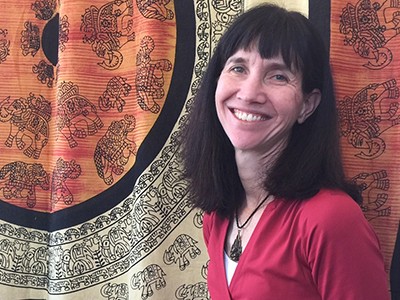
Jennifer Sinor, a professor of English and creative writing, celebrates the release of two completely different books, a memoir and a collection of essays, in the same month.
Two books that seem in different worlds — one a memoir about a childhood molded by military life and the other an exploration of Georgia O’Keefe’s letters.
The one thread connecting both new books is author Jennifer Sinor. She has spent much of her career looking at the way women tell their life stories.
There’s another bond between the books. The origins of Sinor’s memoir, Ordinary Trauma, date back to 1997, while Letters Like the Day: On Reading Georgia O’Keeffe is much newer. But the two books were, by happenstance, published at the same time last month. “It’s like having twins,” says Sinor, a professor of English who teaches creative writing.
Ordinary Trauma: A Memoir (University of Utah Press) examines Sinor’s childhood as the daughter of a U.S. Navy career man whose family was never able to set down roots. Her family’s frequent relocations left them “traveling through places,” she said. “Migratory is the term I use.”
Letters Like the Day is new from the University of New Mexico Press. O’Keeffe was at the vanguard of the modernist art movement, said Sinor. Before her death in 1986, O’Keeffe had moved well beyond traditional realism to portraying emotional truths or, as Sinor explains, “larger truths.”
The artist’s dramatic, largely abstract images “abandoned the narrative line,” said Sinor, instead using magnification, cropping and juxtaposition to portray emotions. “And this is what I was experimenting with in my own work,” she said.
“There was this lineup between what she was doing visually and what I wanted to do on the page,” she said. “I wanted to find other ways to move through a piece other than narrative.”
In her letters, most written long before she was a celebrated artist and married to photographer Alfred Stieglitz, O’Keeffe describes the many ordinary moments in her days. Those same kind of moments — routine and seemingly natural — prompted Sinor to look back to her childhood and wonder about the true nature of what she considerd normal.
“I’m interested in ordinary moments and the ways in which they are extraordinary,” she says.
As a child and teenager, Sinor moved to naval bases worldwide, primarily bouncing between Hawaii and the Pentagon. Later, as a doctoral student, she chose to study trauma, particularly acute psychological trauma resulting from violent acts or combat. Such events, she says, fundamentally change an individual.
Trauma, she said, “is not held in the verbal part of our brains. That is why we can’t talk about it. It’s more primal that that — that’s how terrible it is. We’re haunted by these things we can’t speak about.”
That’s extraordinary trauma. But, Sinor wondered, does trauma also result from events that at the time seemed routine? She began to think of this as “ordinary trauma.”
Her memoir is set against the backdrop of the Cold War, when attack and devastation seemed forever imminent. “War was what we were all doing,” she said. “We were all preparing for war.”
At the time, she said, her life seemed ordinary because, she explains, “the definition of ordinary is something not remarked on.” But looking back at her 10-year-old and 14-year-old selves, she asks, “was it really so ordinary to be obsessed by nuclear annihilation?”
Ordinary trauma, she adds, “is not remarked on, and yet it wounds you.”
Sinor first wrote the memoir for a popular audience that largely prefers a story line in books. But by 2008 she was rewriting the manuscript for a smaller literary press, which allowed her to be “much more playful in terms of the form.”
When working with a more experimental form, she said, the story doesn’t always wind from beginning to end. “There’s so much more room to be creative.”
The result is what Sinor describes as “flash nonfiction.” Like its more famous cousin flash fiction, the writing is compressed into no more than a few hundred words. Each small story, she said, “is like a diamond.”
The gems are linked, she says, “because I am the character running across the entire book. There’s a larger narrative arc that moves from loss to redemption, generally speaking, but then there are all these small bits.”
The memoir hits the mark, according to a review on Amazon. “Through her brilliant use of metaphor, (Sinor) shows us how and why these hidden wars are emotionally, and sometimes literally, deadly. This is an extraordinary, harrowing and stunning book.”
Sinor completed the Georgia O’Keefe book during a hiatus from Ordinary Trauma.
“The memoir was killing me, and I needed something else to focus on,” she said. At the time, the letters of O’Keefe, sealed at her request for 20 years following her death, had been released. Sinor was drawn to O’Keeffe’s career-long efforts of “generating a feeling rather than giving information.”
Letters Like the Day is a collection of essays. The reader will learn much about O’Keeffe’s life and obsessions, but “this is not a biography,” Sinor said. “Instead, it’s much more experiential. You’re going to feel it.”
Related links:
Jennifer Sinor interviewed for UPR’s Access Utah Feb. 28
Writer and contact: Janelle Hyatt, 435-797-0289, Janelle.Hyatt@usu.edu
SHARE
TRANSLATE
Comments and questions regarding this article may be directed to the contact person listed on this page.


