
CEHS Researcher Seeks to Remove Literacy Barriers in Engineering
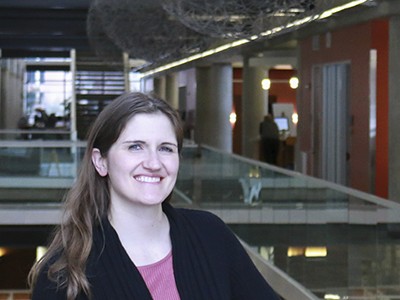
Amy Wilson-Lopez has received a five-year, $802,000 career award from the National Science Foundation to continue filling gaps in engineering educators' understanding.
Much has been said, written and researched about the need for graduates with engineering skills. But what if one of the barriers to engineering education is literacy?
It’s a question Amy Wilson-Lopez has researched extensively. Now, the Utah State University researcher has received a five-year, $802,000 career award from the National Science Foundation to continue filling gaps in engineering educators’ understanding. Her goal is to find the best ways to help students read, understand and write about engineering concepts.
Wilson-Lopez is an assistant professor in the School of Teacher Education and Leadership, located within the Emma Eccles Jones College of Education and Human Services. She is the author of numerous articles on engineering and literacy, as well as the peer-reviewed book Reading and Representing Across the Content Areas: A Classroom Guide. Her latest grant will allow her to work with teachers of 12 middle school technical education classes that include youth who are underrepresented in engineering. Funding was also provided to support two graduate students.
Engineering has its own language and vocabulary, with terms like lift, drag, force and gravity. Engineers need not only understand these terms, but use them in written arguments in behalf of their designs.
“It’s really demoralizing to learn if you’re not understanding,” Wilson-Lopez said.
Her project will emphasize comprehension, vocabulary, writing-to-learn and argumentation.
In addition to working on the words needed in engineering, she will work to help them understand why engineering skills matter.
“A lot of youth don’t see how engineering relates to their backgrounds,” she said.
What’s more, they may not understand that they can apply engineering concepts to their future careers, even if they don’t choose to be engineers. Many products and processes have been improved when people in the field ask: How can I make this work better?
The students will work with model airplane design in one of the first projects.
“It’s really engaging when they throw a plane and see how far it goes and if it goes straight,” Wilson-Lopez said. “They’ll take the information they read and they’ll apply it immediately to the design … I think that component is very motivating.”
Contact: Amy Wilson-Lopez AmyAlexandra.Wilson@usu.edu
Writer: JoLynne Lyon 435-797-1463
SHARE
TRANSLATE
Comments and questions regarding this article may be directed to the contact person listed on this page.


