
Cache Valley students keep an eye on Mount St. Helens
By Amanda Cannon in the Hard News Cafe
November 3, 2004 | With scientists predicting an eruption at Mount St. Helens, some college students in Cache Valley watch with excitement and anxiety.
Jana Olney, a nursing student at Bridgerland Applied Technology College, said she has seen Mount St. Helens, and her mom has some ash from the eruption of 1980. She said it is interesting to watch the news with this perspective.
"It's kind of cool to learn what's going on," Olney said. "I like learning about volcanoes and what they can do."
Garry Denke said Steven Bergman, a research volcanologist and geologist at the University of Texas at Dallas, hopes the recent activity at Mount St. Helens will "attract a new crop of geologists." Denke said, "We can only try."
According to the U.S. Geological Survey, seismic activity at Mount St. Helens began to increase Sept. 23, 2004. Approximately 200 earthquakes which were less than magnitude 1 on the Richter Scale were recorded on that day.
The U.S. Geological Survey announced a level two volcano advisory Sept. 29. According to the survey, seismic activity had increased, creating concern that the volcano could erupt.
According to an update Oct. 14, there is an "intensely deforming and uplifting area on the south side of the 1980-86 lava dome and on the new lobe of lava in the western part of that area." The report indicated ash-rich jets rose tens of meters into the air.
The report said magma is at a shallow level and coming onto the surface, making the lava dome grow. The report said researchers expect fluctuations in the level of lava to continue. It said the volcano could explode with little warning.
This information makes some students worry. Katie Willis, a sophomore at Utah State University, said she is in a geology class where they have talked about Mount St. Helens.
"I'm a little frightened, to tell the truth," Willis said.
Jenna McMillan, a freshman at Utah State, said she agrees.
"I think it's really scary," McMillan said. "I think people should be cautious because it could explode again."
Professors at Michigan Technological University have created a program to keep the public informed about volcanoes. These professors indicate that volcanoes give warning signs before eruptions. The Volcanoes and People project said eruptions can be preceded by "weeks, months or even years of strange changes that tend to get more numerous and noticeable as the time of eruption approaches."
Amy Brady, a sophomore majoring in dietetics, said she has heard stories from friends about new activity at Mount St. Helens.
Jana Olney, a nursing student at Bridgerland Applied Technology College, said she has seen Mount St. Helens, and her mom has some ash from the eruption of 1980. She said it is interesting to watch the news with this perspective.
"It's kind of cool to learn what's going on," Olney said. "I like learning about volcanoes and what they can do."
Garry Denke said Steven Bergman, a research volcanologist and geologist at the University of Texas at Dallas, hopes the recent activity at Mount St. Helens will "attract a new crop of geologists." Denke said, "We can only try."
According to the U.S. Geological Survey, seismic activity at Mount St. Helens began to increase Sept. 23, 2004. Approximately 200 earthquakes which were less than magnitude 1 on the Richter Scale were recorded on that day.
The U.S. Geological Survey announced a level two volcano advisory Sept. 29. According to the survey, seismic activity had increased, creating concern that the volcano could erupt.
According to an update Oct. 14, there is an "intensely deforming and uplifting area on the south side of the 1980-86 lava dome and on the new lobe of lava in the western part of that area." The report indicated ash-rich jets rose tens of meters into the air.
The report said magma is at a shallow level and coming onto the surface, making the lava dome grow. The report said researchers expect fluctuations in the level of lava to continue. It said the volcano could explode with little warning.
This information makes some students worry. Katie Willis, a sophomore at Utah State University, said she is in a geology class where they have talked about Mount St. Helens.
"I'm a little frightened, to tell the truth," Willis said.
Jenna McMillan, a freshman at Utah State, said she agrees.
"I think it's really scary," McMillan said. "I think people should be cautious because it could explode again."
Professors at Michigan Technological University have created a program to keep the public informed about volcanoes. These professors indicate that volcanoes give warning signs before eruptions. The Volcanoes and People project said eruptions can be preceded by "weeks, months or even years of strange changes that tend to get more numerous and noticeable as the time of eruption approaches."
Amy Brady, a sophomore majoring in dietetics, said she has heard stories from friends about new activity at Mount St. Helens.
Brady said, "I have come to the conclusion that even though Washington is a beautiful green place, I'm glad I'm living in desert Utah right now."
According to a report from the Smithsonian Institute, small lahars have been spilling out of the lava dome. Lahars are also referred to as volcanic mudflows or debris flows, the report said, and they usually form by the rapid melting of snow and ice by pyroclastic flows.
People living outside of Cache Valley are also concerned about what could happen if there is an eruption. In a newsgroup discussion, "Lava Man" said people do not know how big a possible eruption would be.
"The fact that the volcano today is so young attests to the fact that it blows itself to pieces regularly," he said.
Although she is not worried about the consequences of an eruption, Mary Sharples, a senior majoring in history, said, "Mount St. Helens only proves that mankind cannot conquer nature."

Aerial view of plume from Mount St. Helens, Oct. 5, 2004 (Photo courtesy U.S. Geological Survey)
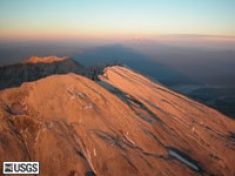
Sunset at Mount St. Helens October 4, 2004 (Photo courtesy U.S. Geological Survey)
TOPICS
Geosciences 91storiesSHARE
TRANSLATE
Comments and questions regarding this article may be directed to the contact person listed on this page.


