
ASPIRE Students Representing USU at IFEC 2025 Competition
By Kayleigh Kearsley |
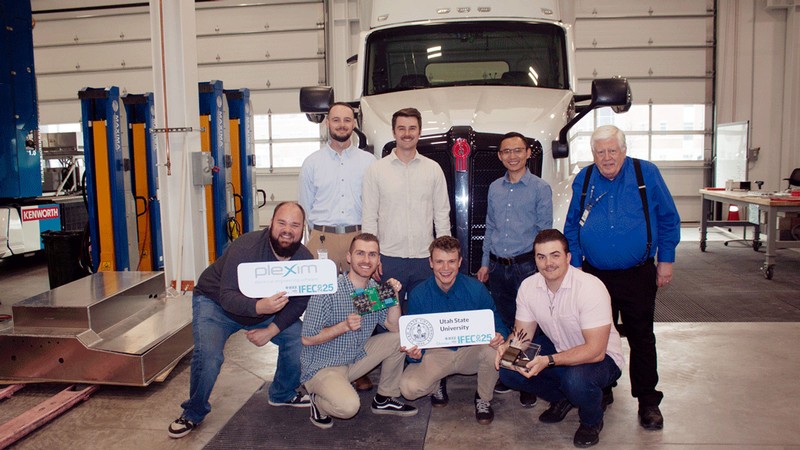
(Photo Credit: USU/Kat Webb)
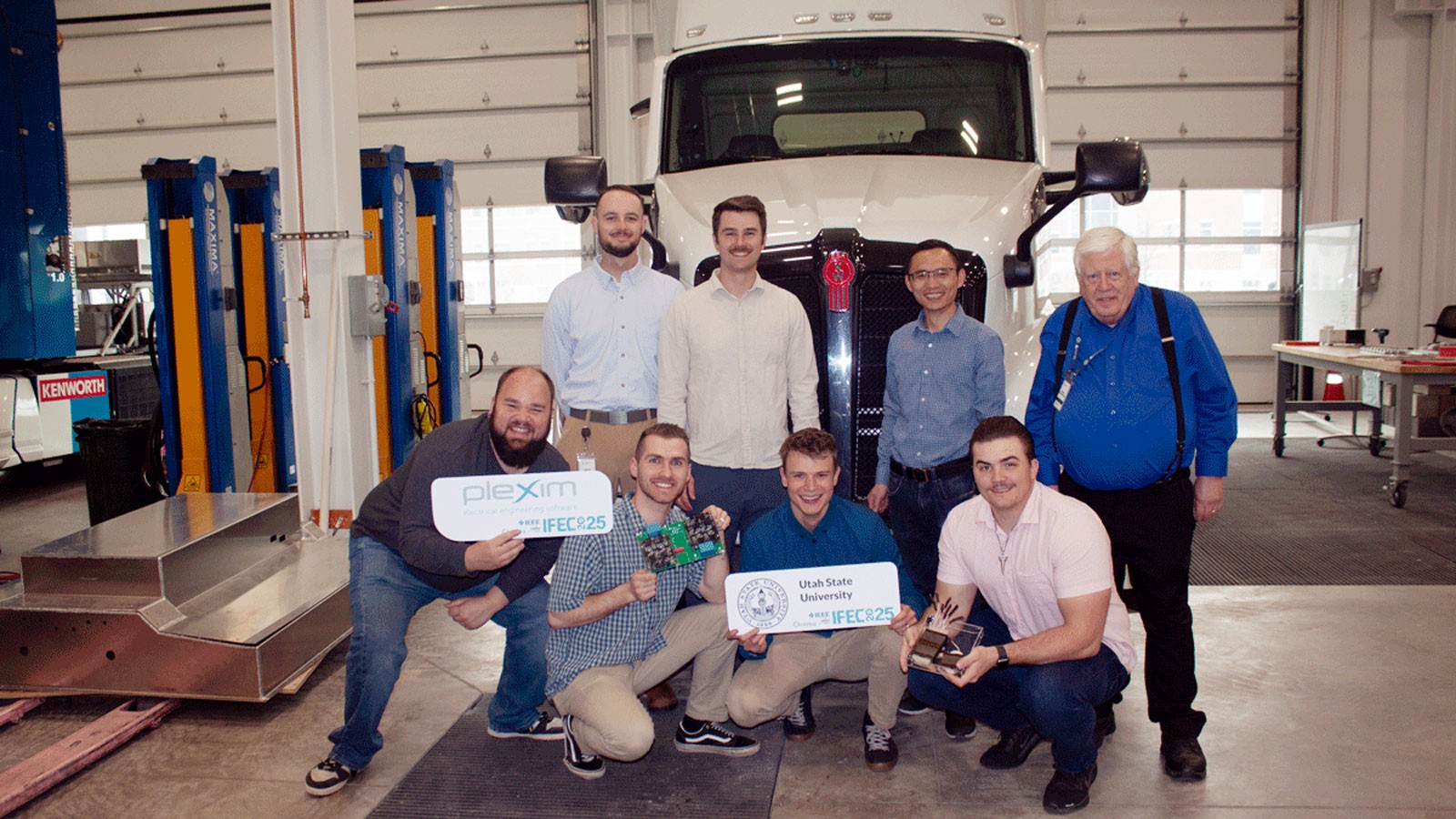
A team of students and faculty from ASPIRE at Utah State University has been accepted to participate in the final event of the International Future Energy Challenge, which will take place in Taiwan this summer.
Out of the 12 teams that participated in the semifinals in March, the USU team is one of eight that were selected to participate in the challenge’s final competition, creating an isolated DC-DC converter with a fast transient response and low noise level.
“We have a lot to accomplish in the next three months to complete the design and build the hardware,” said Bryce Hesterman, the engineering adviser of the team. “The contest topics are chosen to be somewhat difficult, and it seems to me that the judges are looking for innovative solutions to the challenging requirements.”
The team’s faculty adviser, Hongjie Wang, a professor of electrical and computer engineering at USU, is excited for his students to participate in this international competition because it’s a great opportunity for future professional careers.
“Having the team entering the final stage means we have a really strong team from USU and ASPIRE, and it shows the strength of our power engineering group,” Wang said. “It also shows the strong support that we are providing to our students from ASPIRE, the ECE department, and College of Engineering, and demonstrates our effectiveness in undergraduate student training, student education and engineering workforce development.”
This undergraduate research team is comprised of team lead Josh Christiansen and team members Zac Bradley, Austin Hardy and Cole Krmpotich, who are all electrical engineering majors at USU. Assisting this team are graduate student advisers Mckay Waite and Jaron Bono, who were both winners of previous IFEC competitions, with Hesterman and Wang as advisers.
Hesterman said that the variety of expertise on the team — from industry to academic, students to advisers — has been valuable for everyone involved, and the students agree.
“We have spent countless hours on this project, and to make it to the finals felt like all our hard work has paid off,” Bradley said. “We definitely understand the hardest part is not over, however. We don't want to simply make it to the finals, we want to create a project that functions fully, is unique and ultimately wins the competition.”
IFEC is an annual international undergraduate student competition in power electronics and their design, implementation and testing. The entire competition spans approximately nine months with an initial proposal stage, a semi-final stage, and the final stage, which is on-site in Taiwan.
Learn more about the competition here, including the other teams.
Headquartered at Utah State University, ASPIRE is a National Science Foundation Engineering Research Center. ASPIRE has demonstrated expertise in developing, implementing, and managing a range of electric vehicle infrastructure projects and fostering strong partnerships across the EV charging ecosystem. The center integrates multidisciplinary expertise across electrical, civil, and mechanical engineering, as well as economics, marketing, and policy. In 2023, ASPIRE was designated the lead institution in building Utah’s Intelligent Electrified Transportation Plan. More information on the center can be found at aspire.usu.edu, and more on Utah’s electrification efforts can be found at utahelectrification.com.
WRITER
Kayleigh Kearsley
Marketing & Communications Intern
ASPIRE
A02359994@usu.edu
CONTACT
Hongjie Wang
Assistant Professor
Department of Electrical and Computer Engineering
435-797-0591
hongjie.wang@usu.edu
Bryce Hesterman
Research Engineer
College of Engineering
bryce.hesterman@usu.edu
SHARE
TRANSLATE
Comments and questions regarding this article may be directed to the contact person listed on this page.


