
Another Salt Lake: USU Professor to Study Argentina's Mar Chiquita
As he has for the past 20 years, Utah State University professor Wayne Wurtsbaugh will spend next spring studying a vast, shallow saline lake that supports the migration of large bird populations. But in 2011, he’ll be conducting research in the southern hemisphere on Argentina’s Mar Chiquita rather than North America’s Great Salt Lake, his usual study site.
Wurtsbaugh is a 2010 recipient of a Fulbright Senior Fellowship. He travels to South America in February 2011 to conduct a short course on aquatic ecology for graduate students and advanced undergrads and pursue limnological research at Universidad Nacional de Córdoba.
“Mar Chiquita is a huge lake — about 5,000 square kilometers compared with Great Salt Lake that is about 4,200 square kilometers,” says Wurtsbaugh, professor in USU’s Department of Watershed Sciences. “Yet very little is known about Mar Chiquita’s ecology despite the fact that water development threatens the very existence of the lake.”
Like Great Salt Lake, Mar Chiquita underwent massive flooding in the 1980s. Water levels have receded dramatically yet vegetation killed by salt water remains.
“It’s hard to convince residents, whose memories of the flooding are still vivid, that the lake is actually shrinking,” Wurtsbaugh says. “That’s why generating more research on the lake is important.”
As part of his USU practicum course in limnology, the study of inland waters, Wurtsbaugh and his students have conducted years of studies on Great Salt Lake that have been submitted to government agencies and initiated action. Several of these reports have sparked major research projects on the lake, including recent investigations of mercury contamination.
“Students recognize the importance of research and its implications for resource management,” he says. “As a result, they become more motivated. I hope to promote a similar program in Argentina.”
While Mar Chiquita isn’t adjacent to a large metropolitan area, it is, like Great Salt Lake, impacted by surrounding farming, grazing, mining and the threat of water loss.
“This will be an opportunity to get students involved in the scientific process and refine their skills in using the scientific method to collect and analyze data,” Wurtsbaugh says. “We’ll also get them involved in working with agency professionals.”
The timing of the Argentinean course will allow the students to present at the 11th Triennial Conference of the International Society for Salt Lake Research that will be held at the resort community of Miramar on the shores of Mar Chiquita in May 2011.
“This conference is typically attended by 100-150 international scientists and managers,” says Wurtsbaugh, who serves on the society’s board of directors. “It will be an ideal venue for novice limnologists to learn more about saline lakes and get to know the international community of scientists studying these waters.”
Related links:
- Universidad Nacional de Córdoba, Argentina
- USU Department of Watershed Sciences
- USU College of Natural Resources
Contact: Wayne Wurtsbaugh, 435-797-2584, wayne.wurtsbaugh@usu.edu
Writer: Mary-Ann Muffoletto, 435-797-3517, maryann.muffoletto@usu.edu
Wayne Wurtsbaugh, professor in USU's Department of Watershed Sciences, received a Fulbright Senior Fellowship to teach and conduct research at Argentina’s Universidad Nacional de Córdoba in spring 2011.
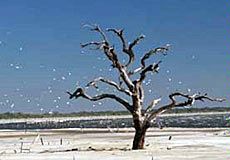
Gulls flock to a tree killed by salt water along the shores of Argentina's Mar Chiquita. The vast saline lake shares many similarities with Utah’s Great Salt Lake. Photo by Wayne Wurtsbaugh.
SHARE
TRANSLATE
Comments and questions regarding this article may be directed to the contact person listed on this page.


