
Acclaimed, Controversial Play 'N*GGER WETB*CK CH*NK' Presented at USU
The national tour of the play “N*GGER WETB*CK CH*NK,” a show about respect, will be performed at Utah State University Nov. 6 at 7:30 p.m. in the Kent Concert Hall.
It is a performance that looks at words, peels away their meanings and examines who has the license to use them, said Keri Mecham, USU associate director of Student Involvement and Leadership Center.
It is a performance that looks at words, peels away their meanings and examines who has the license to use them, said Keri Mecham, USU associate director of Student Involvement and Leadership Center.
The conversation this acclaimed and controversial production will likely spawn regarding language and respect will continue into the following week during USU’s Diversity Week, said Moises Diaz, director of Multicultural Student Services.
Tickets are now on sale. Some language in the performance may not be suitable for children under 13. The Kent Concert Hall is on the east end of campus approximately at 1110 East 610 North.
Tickets can be purchased at the Dee Glen Smith Spectrum Ticket Office or the Taggart Student Center Service Center. Advance telephone reservations and purchases can be made at the Spectrum Ticket Office (approximately 900 East 900 North, Logan), (435) 797-0305. Tickets can only be purchased in person at the Taggart Student Center Service Center, TSC 212. Tickets will be sold at the door the night of the performance. Tickets are $10 for the public and $3 for USU students with current ID.
Already performed at more than 70 university and college campuses nationwide, the production, with the subtitle “Three Hateful Words: A Dialogue on Language and Respect,” will make three other stops in Utah, including Ogden, Salt Lake City and Park City.
Winner of the 2003 award for “Best Play” from the American Readers Theater Association, N*W*C charges into the dangerous territory of race, but without the predictable anger and angst, according to press materials.
“We get that the title is tough for some people, but it’s real,” said Miles Gregley, actor and co-writer. “We all got called those words and just think there is nothing wrong about confronting them head-on. Our philosophy is that there shouldn’t be words out there floating around that can bring someone to their knees by just saying them out loud, you know?”
The production is sponsored by the College of Humanities, Arts and Social Sciences, the Utah Arts Council and the Associated Students of USU.
The decision to bring this to USU was widely discussed by the ASUSU programming committee, said Mecham.
She said that early on, when students were deliberating on whether to bring N*W*C* to campus, they thoroughly reviewed the press materials and video segments and asked the opinion from a variety of fellow students.
Also, by co-sponsoring with the College of Humanities, Arts and Social Sciences and ASUSU, leaders felt it was a great opportunity to integrate an academic component to the performing arts series, Mecham said.
“I appreciate that the play combines both laughter and poignant moments in the real-life experiences of these actors,” said Kyle Milne, last year’s ASUSU Arts and Lectures director. “This is an opportunity to create dialogue on the sensitive topic of race and that has the possibility of building understanding among the campus community.”
From an academic perspective, the production is beneficial because the arts are a cultural phenomenon, said Tom Peterson, who has included the performance in his “Civilization: The Creative Arts” 1330 class curriculum for fall semester.
“The arts are an indicator of the existence of a civilized society, and this production shakes the very roots of what society can do to segments of the melting pot we call America,” he said. “This three-man play will allow students to experience the power of language, the power of communication, the power of the arts.”Peterson points out that an important part of the performance is the inclusion of scheduled class discussions where students will have the opportunity to interact with the actors in an effort to discover that thin line between reality and theater.
Can theater cause change? Can it at least provide a springboard for discussion?
“Our intent is that through student interaction with the actor-writers and attendance at this performance, these questions can be better understood, if not completely answered,” he said. “Can the arts change social behavior? They can certainly open the door to an analysis of individual thoughts about race and the use of racial slurs.”
The public is welcome to attend the class discussions. For times and location information, contact Mecham at 435-797-2912. Details are also being posted on the university’s Web site.
In addition to class discussions, the actors will also be available for a public discussion Nov. 9, the Friday prior to the university’s annual Diversity Week, Nov. 12-16.
Diaz, director of Multicultural Student Services, said the production, a week prior to Diversity Week, does draw attention to issues and notions that are often unaddressed. The goal ultimately is to promote education and constructive dialogue on racial issues.
“As entertainment it could surely reach a segment of campus not prone to attend academic lectures on racism,” Diaz said. “While everyone will not agree with their approach, the artists represent themselves and their human stories in a way that resonates with many. Its candor can be seen as necessary at a time when some believe discussion of racism is irrelevant.”
Sonny Bryant, ASUSU Campus Diversity and Organizations vice president, is organizing activities for Diversity Week. Food, guest speakers, workshops and entertainment highlight the week. The week concludes Friday, Nov. 16, with a cultural showcase and the presentation of the university’s Diversity Awards, among other activities. Details will be released at a later date.
N*W*C* blends theater, hip-hop, stand-up comedy, slam poetry and true-life stories in an original style. Gregley mixes it up with two fellow performers, Rafael Agustin and Allan Axibal, as the only three cast members. They are men of color, including one who lived in the United States as an undocumented citizen while growing up. One is Hispanic-American, one African-American and one Asian-American. As the show’s co-authors, the painful discrimination they faced as young men growing up in Southern California is reflected in the production, according to press materials.
They met at community college in Southern California where they became good friends and transferred together to UCLA’s School of Theater, Film and Television.
N*W*C premiered in short form in May 2003 at the American Readers Theater Association national theater festival, where it swept every major award, including the Audience Prize and the award for Best Play.
The Los Angeles Times says the trio of versatile actors wields words that empower in disarming ways.
“Don’t let the title fool you: N*GGER WETB*CK CH*NK, which returned to L.A. after a two-year national tour, is wholesome entertainment,” according to a July 9 LA Times theater review. “Yes, racial slurs and occasional profanity can sometimes be good for you — especially when they’re deployed to make a point about the pervasiveness of prejudice and its denigrating unabridged dictionary.”
To preview and receive more background information, visit www.nwclive.com. The USU community and others are also welcome to discuss the performance on the Utah State Today blog in the comment section below.
Contact Keri Mecham (435) 797-2912
Writer: John DeVilbiss (435) 797-1358
Writer: John DeVilbiss (435) 797-1358
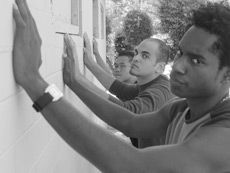
The cast from N*W*C will perform its award-winning production Nov. 6 at USU. (Photo by Carol Petersen.)
SHARE
TRANSLATE
Comments and questions regarding this article may be directed to the contact person listed on this page.


