
Abby Benninghoff is 2016 Outstanding Graduate Mentor
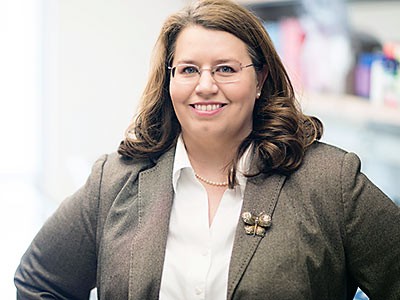
Faculty member and researcher Abby Benninghoff is the 2016 University Outstanding Mentor.
College of Agriculture and Applied Sciences associate professor Abby Benninghoff is the recipient of the 2016 Utah State University Outstanding Graduate Mentor Award.
Since joining USU in 2010, Benninghoff has served as major advisor for five graduate students, three master’s students and two doctoral students, several of whom have continued their training in Ph.D. or post-doctoral programs. Her service on 15 additional graduate advisory committees in her department, college and the College of Science indicates her mentorship is highly respected and sought after.
“Although Abby has only been at USU for six years, her nomination materials presented a compelling picture of Abby’s substantial contributions not only to her own students, but to other students in her department,” said Richard Inouye, associate vice president for research and associate dean of graduate studies. “Notably, she is also seen by her faculty colleagues, including those who are more senior than Abby, as an example of an excellent mentor, and an example that they seek to live up to.”
Animal, Dairy and Veterinary Sciences Department Head Dirk Vanderwall said he’s also impressed with the impact Benninghoff has made on her department in a short period of time.
“Her commitment to excellent mentoring is evident in all aspects of her role as a faculty member,” Vanderwall said.
Benninghoff said her leadership style is heavily influenced by her graduate school experience. While completing a Ph.D. at the University of Austin at Texas and a postdoc at Oregon State University, her mentors demonstrated the importance of balancing high expectations while setting students up for success.
Her research program studies the connections between environment and gene function. Some of her students study how diet influences genes in the colon, and how affected genes influence cancer risk. They’ve found that the typical Western diet — energy dense and nutrient poor — when fed to rodents, causes cancer development to be much more aggressive.
“My students work as independently as possible because that’s how they learn best,” she said. “But I’m here in case they need help and my door is always open to them. I’m ready to work with them whenever they need me.”
Valuing the opportunity to learn with her students, Benninghoff said she considers them her colleagues.
“We laugh as much as we work,” she said. “We learn from each other, which is really exciting — I get to learn new things from the students I’m mentoring. I look at it as a team; we’re all together on the same team. Our pursuit, our goal is new knowledge and that team works best when there’s a good mentor-mentee relationship.”
In letters of recommendation, Benninghoff’s students spoke of her dedication to foster such relationships. Former student Aaron Davis said it wasn’t uncommon for Benninghoff to visit with each student in the graduate student office area to catch up on progress or schedule a time to further discuss how she could help.
“I’ve been around a lot of professors and I’ve never met anyone who invests as much time and energy into students as she does,” Davis said.
Stephany Perez Monsanto, a master’s student from 2011 to 2013, said Benninghoff is unique in her ability to motivate and inspire students through constructive criticism and unwavering support.
“In the lab, she expects quality work from everyone,” Monsanto said. “When inspiration was not enough motivation for me, her high expectations kept me working hard. More than just expecting the best of you, she seems so certain that you can do better that you have no other option but to believe it yourself. Her support helped me achieve much more than I ever thought I could.”
Beyond a commitment to graduate student research, Benninghoff has championed efforts to work with students across campus to improve professional science communication. She teaches essential skills in writing, preparing scientific manuscripts, presentations and public communication through free workshops and a semester-long professional development course.
“Why not have some formal training in this area so students can learn and practice these skills early on in their graduate career?” Benninghoff said. “When they’re ready to give their first professional presentation, they shouldn’t have to worry about putting together a good powerpoint presentation.”
“The impact of this course on the quality of work generated by our students is unmistakable,” said Vanderwall. “In just a few years, the professionalism exhibited by our students has markedly improved, most notably in the area of presentations.”
Benninghoff is committed to graduate student professional development across all disciplines. She doesn’t see it as extra work, but an essential part of her role as a faculty member.
“When I see a need, I want to do something to help fulfill that need,” she said. “It’s instinctive to try and fix a problem when I see one.”
The University Outstanding Graduate Mentor Award recognizes faculty excellence in the complex process of mentoring graduate students to prepare them for productive careers. Nominees should be effective advisors who facilitate degree completion, model sound scholarship and ethical behavior, help students understand and benefit from departmental and university resources, provide emotional support, offer constructive criticism and involve students in publishing and other professional activities. The $2,000 award is presented at the Research Awards Gala, as well as recognition in the printed Commencement program.
Related links:
- USU Department of Animal, Dairy and Veterinary Sciences
- USU College of Agriculture and Applied Sciences
- USU Research Week
- USU Office of Research and Graduate Studies
Contact: Abby Benninghoff, abby.benninghoff@usu.edu
Writer: Manda Perkins, RGS Communications, manda.perkins@usu.edu
SHARE
TRANSLATE
Comments and questions regarding this article may be directed to the contact person listed on this page.


